Many hospitality organizations believe they have automated QA.
What they often have is automated fragility.
Hundreds of test scripts run across environments. Dashboards show automation coverage. Regression suites execute on schedule. Reports are generated. On the surface, the organization appears to have achieved testing maturity.
Then a third-party API changes. A PMS workflow is updated. A mobile interface is redesigned. A payment gateway modifies a response field. A loyalty rule changes. A digital key integration introduces new behavior.
Suddenly, hundreds of tests fail.
Not because the business workflow is broken, but because the automation itself is brittle.
This is the Automation Illusion: the belief that a large number of automated scripts equals quality confidence. In reality, many automation programs become expensive to maintain, difficult to trust, and disconnected from the business risk they were supposed to reduce period.
Hospitality technology is especially vulnerable to this trap. Modern hospitality ecosystems depend on property management systems, booking engines, payment platforms, loyalty systems, distribution channels, mobile apps, cloud services, and connected guest devices. A single change in one part of the ecosystem can create a ripple effect across test suites, integrations, and guest-facing workflows.
The answer is not to abandon automation. The answer is to move from traditional QA automation to AI-assisted Quality Engineering — automation that is more intelligent, more governed, and more connected to real business context period.
That is the idea behind mroads' Agentic Framework: an approach that combines AI-assisted workflows, reusable accelerators, and human-led review across the full testing lifecycle.
Why the Automation Illusion Is So Expensive
Test automation usually begins with good intentions. Teams want to reduce manual regression effort, improve release velocity, catch defects earlier, and create repeatable validation. They automate UI flows, API checks, regression cases, and smoke tests. Over time, the number of scripts grows.
But script volume is not the same as QE maturity.
When automation is built without a strong architecture, it often becomes fragile. Scripts depend on unstable selectors. API checks are not updated when contracts evolve. Test data becomes stale. Failures become noisy. Engineers spend more time investigating false failures than improving assurance coverage.
Automation Illusion | What Actually Happens |
|---|---|
More scripts mean more confidence | More scripts can mean more maintenance debt |
High automation coverage means lower risk | Coverage may ignore critical business workflows |
Passing tests mean release readiness | Tests may validate outdated assumptions |
Failed tests mean product defects | Failures may come from brittle scripts or unstable environments |
Automation reduces manual work permanently | Poorly designed automation requires constant human repair |
AI can fully replace quality judgment | AI without context can generate irrelevant or risky coverage |
In hospitality, this problem becomes more serious because the ecosystem changes constantly. A PMS vendor can change reservation status rules. A loyalty engine can update tier logic. A mobile redesign can break UI selectors. A payment gateway can alter authorization behavior.
If test automation is not designed to understand change impact, it becomes another operational system to maintain — one of the reasons mroads built self-healing recovery directly into its automation frameworks rather than treating maintenance as a separate cleanup exercise.
Why Hospitality Automation Breaks Faster
Hospitality platforms are highly integrated by design. A single guest journey may involve:
- Booking engine
- PMS
- CRM
- Loyalty platform
- Distribution and channel integrations
- Mobile app
- Digital key and connected room systems
- Cloud infrastructure
- Payment gateway
Each dependency can change independently. This makes hospitality Quality Engineering different from testing a closed application. The framework must deal with shifting interfaces, third-party systems, asynchronous workflows, state changes, and real-time business rules.
Dependency | Automation Risk |
|---|---|
PMS | Reservation states, room assignment logic, or availability rules change |
Distribution & channel integrations | Rate, availability, and inventory payloads shift |
Payment gateways | Authorization, refund, or settlement behavior changes |
Loyalty systems | Eligibility, tier rules, and offer logic evolve |
Mobile apps | UI changes break brittle selectors |
Digital key & connected room systems | Device or integration behavior changes |
Cloud infrastructure | Scaling behavior affects timing and test stability |
In this environment, full automation is the wrong goal. The better goal is adaptive, governed assurance: automation that understands business workflows, detects change impact, recommends coverage, and remains accountable to human judgment.
From Full Automation to the Agentic Framework
The future of Quality Engineering is not fully manual. It is not fully autonomous either. It is agentic — AI and humans playing different but connected roles.
AI is strong at high-volume pattern discovery. It can scan requirements, API specifications, schemas, logs, and defect histories faster than humans, and identify impacted workflows, suggest test cases, summarize failures, and recommend regression coverage.
Human QE Architects are strong at judgment. They understand business priorities, compliance risk, edge cases, operational consequences, guest experience, and release trade-offs. They know when an AI-generated test is useful, when it is irrelevant, and when it creates false confidence.
The Agentic Framework combines both, structured across three connected layers:
1. AI-Assisted QE Workflows — requirements and scenario generation, test case review and optimization, regression impact and prioritization, test data support, automation maintenance, defect triage and root-cause analysis, and quality reporting. AI helps identify requirement gaps, duplicate tests, high-risk regression areas, and failed-test evidence, letting QE teams focus on business-critical validation and release readiness.
2. Connected Engineering Ecosystem — the framework integrates with established toolchains rather than replacing them: UI automation (Selenium, Cypress), API testing (ReadyAPI, Postman), CI/CD pipelines (Azure DevOps, Jenkins, GitHub), test management (HP ALM, Zephyr, Xray, Jira), observability and logs (AppDynamics, Splunk, ELK), and data sources across code repositories, requirements, and environments.
3. Human & Enterprise Governance — every AI suggestion is validated by a qualified engineer. Script changes, data usage, and recommendations require approval. Enterprise-grade models operate within approved environments, with no client data used for public model training. Prompts, outputs, and actions are logged for audit and traceability, and a risk-based scorecard supports release decisions — AI provides insight and recommendations, but humans make the release call.
A continuous feedback loop closes the model: insights and outcomes from every release feed back in to improve the underlying models and accelerate quality — the same principle that anchors the Quality Command Center.
In one enterprise automation implementation, mroads' self-healing automation — built using AI-assisted engineering with tools such as Cursor, GitHub Copilot, and Atlassian Rovo — reduced CI/CD automation maintenance significantly while lowering flaky test failures by over 60%. This is the direct answer to the Automation Illusion: fewer false failures, less time spent investigating noise, and more automation hours redirected toward real coverage gaps.
AI-Assisted Workflows in Practice
Traditional QA discovery often takes weeks. In complex hospitality environments, knowledge is scattered across tools, teams, vendors, and systems. AI-assisted scenario generation helps accelerate this by synthesizing requirements, API specifications, existing test cases, and defect histories into acceptance criteria and test conditions — a structured starting point rather than discovery from scratch.
Example: A mobile check-in workflow update can touch guest authentication, reservation lookup, PMS sync, payment hold, and digital key issuance. AI-assisted synthesis surfaces the likely impact map before manual analysis begins.
AI reviews, enriches, and optimizes test cases for coverage and redundancy, and assesses change impact to prioritize tests based on risk and business criticality. The output is a candidate set — not an automatic assurance asset. AI can overgenerate or miss operational nuance, which is why every recommendation moves into human review before it becomes part of the regression suite.
Example: For a loyalty offer update, AI may suggest tests for eligibility rules, redemption, and pricing calculation. A QE architect determines which scenarios are business-critical, which are redundant, and which require deeper integration validation.
AI without context is noise. This is the core governance principle behind the Agentic Framework. Human QE architects and product owners ask:
- Does this test flow represent a real hospitality use case?
- Does it protect a revenue-critical or guest-critical workflow?
- Are there compliance, privacy, or payment risks?
- Does this scenario duplicate existing coverage?
- What evidence is needed for release confidence?
AI Agents Are Best At | Human QE Architects Are Best At |
|---|---|
Pattern discovery | Business context |
Change impact analysis | Risk judgment |
Test flow suggestions | Compliance oversight |
Log and trace summarization | Edge case validation |
Regression prioritization | Approval of generated flows |
Maintenance recommendations | Release confidence decisions |
Once candidate flows are reviewed and approved, they become part of the governed automation portfolio — UI automation, API automation, regression suites, and CI/CD quality gates. The difference from brittle automation is that every automated flow has a clear owner, a clear trigger, and a clear purpose: which workflow it protects, which risk it reduces, and what happens if it fails.
Every release produces signals: defects, API changes, latency patterns, test flakiness, and human review decisions. In the Agentic Framework, these signals feed back into the same knowledge base that drives scenario generation and regression prioritization — the framework gets better with every release rather than depreciating as the technology stack changes.
Guardrails That Make AI-Assisted QE Trustworthy
In hospitality, the risks are real — guest data, payment flows, loyalty information, and booking records are all involved. The Agentic Framework's governance layer is built around this:
AI Risk | Required Guardrail |
|---|---|
Hallucinated test scenarios | Source-grounded generation and mandatory engineer review |
Sensitive data exposure | Enterprise-grade models or approved environments; no client data used for public model training |
Irrelevant automation | Product owner and QE architect validation before scenarios enter the suite |
False confidence | Audit-logged prompts, outputs, and actions; risk-based scorecards inform release decisions |
Uncontrolled script generation | Approval gates on every script change, data usage, and recommendation |
AI should not become another black box in the quality process. It should make the process more transparent, more explainable, and more adaptive — with humans making every release decision.
How the Agentic Framework Reduces Automation Debt
In brittle automation programs, teams manually investigate every failure, deciding whether it's a product defect, a script issue, an environment problem, or an upstream dependency change. This takes time and erodes trust.
Within the Agentic Framework, AI helps classify failures and recommend maintenance actions — self-healing scripts adapt to routine UI changes automatically, while pattern-level failures (a renamed schema field, an unstable environment, a latency correlation) are surfaced to engineers with supporting evidence rather than raw noise. This does not remove the human architect. It gives the human architect better evidence, faster.
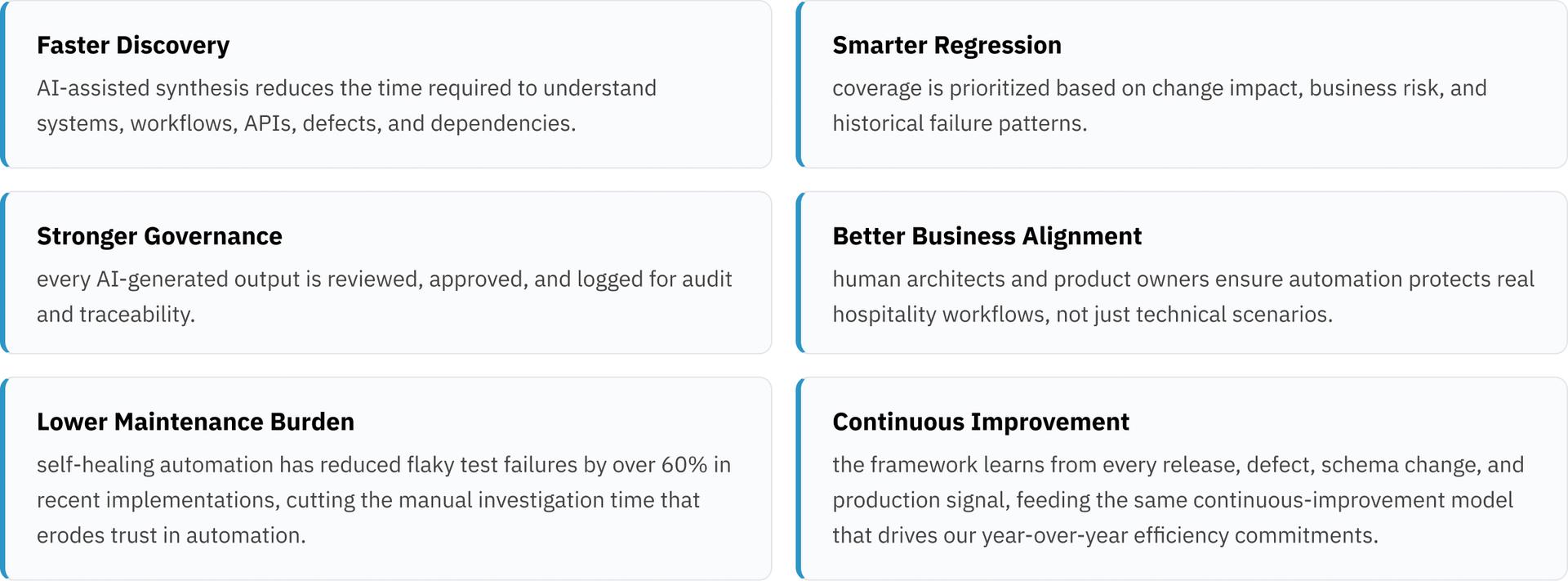
What Hospitality Leaders Gain
The Symbiotic Intelligence Model delivers value because it addresses the real constraints of hospitality QE: speed, complexity, change, governance, and trust.
The mroads Perspective
mroads approaches AI-assisted Quality Engineering through the Agentic Framework because hospitality systems require both scale and judgment. AI agents accelerate discovery, identify patterns, generate candidate flows, detect change impact, and improve maintenance intelligence. Human QE architects provide the oversight needed to keep the framework aligned with real business risk, operational workflows, compliance requirements, and guest experience.
A generated scenario only matters if it protects something important: booking conversion, payment reliability, loyalty accuracy, PMS synchronization, digital key readiness, or guest trust.
The goal is not to automate the old way faster. The goal is to change the economics of release confidence.
Conclusion
The future of hospitality quality is not full automation. Full automation is often an illusion when scripts are brittle, maintenance-heavy, and disconnected from business context.
The future is agentic: AI that scales discovery, pattern recognition, test generation, and maintenance recommendations, governed at every step by human QE architects who provide context, judgment, and accountability.
Hospitality leaders do not need more brittle scripts. They need governed, adaptive assurance — with the evidence to prove it works. That is what the Agentic Framework makes possible.

Quality Engineering Team