How mroads Synapse turns fragmented enterprise systems into intelligent, orchestrated workflows
Large enterprises rarely suffer from a shortage of software.
Most have already invested heavily in content management systems, digital asset platforms, workflow engines, CRM systems, analytics tools, regional portals, partner applications, and custom integrations. Each of these platforms usually performs its assigned function well. The problem begins when the enterprise needs them to work together as one coordinated operating system.
A promotional campaign is no longer just a content task. It may involve approved copy in Adobe Experience Manager, product or property assets in one or more DAM platforms, regional approvals in a BPM system, customer targeting in CRM, loyalty rules, compliance requirements, localization needs, analytics tags, and downstream publishing across multiple digital channels.
In theory, the enterprise owns all the systems required to make this happen. In practice, execution still depends on manual coordination, brittle integrations, disconnected approvals, duplicated assets, inconsistent metadata, and limited visibility across the full workflow.
The next stage of enterprise modernization is not simply about adding another platform. It is about creating an intelligent orchestration layer that can sit above the existing technology landscape, understand business intent, coordinate systems, route tasks, enforce policy, and turn fragmented workflows into verified enterprise action.
The Enterprise Fragmentation Problem
For years, enterprise architecture has been shaped by specialization. Each major system became the best place to manage a specific function.
AEM became the home for structured content and digital experiences. DAM platforms became the repository for brand assets, photography, video, templates, and campaign materials. BPM tools became the mechanism for approvals and operational sign-offs. CRM systems became the layer for customer data, segmentation, and relationship management. Analytics platforms became the source of performance insight.
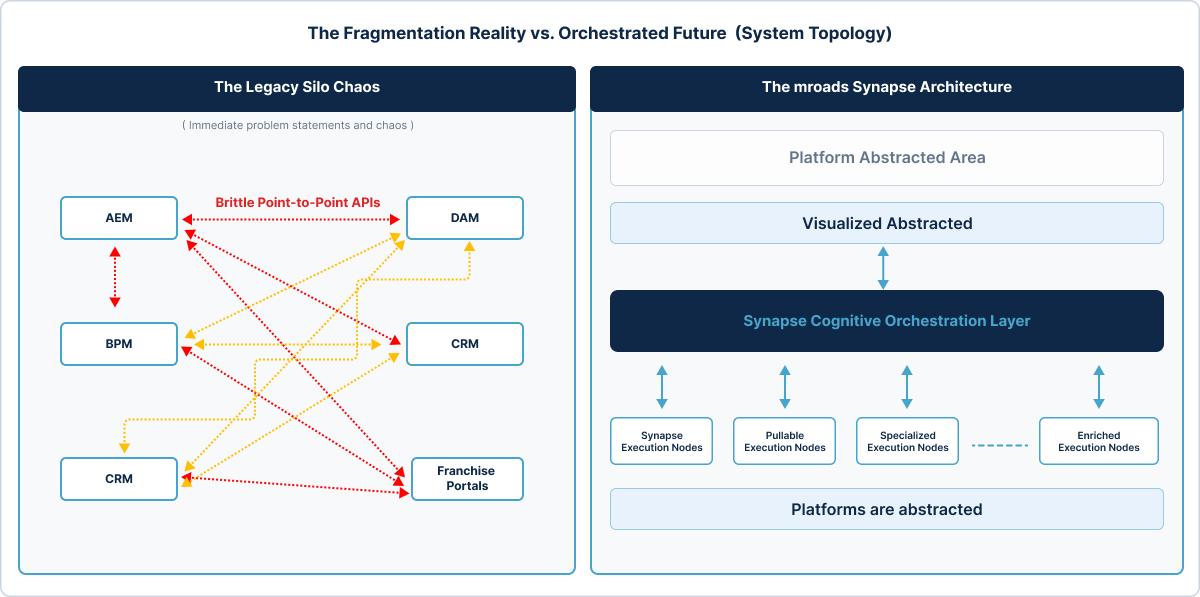
When a workflow crosses multiple systems, the enterprise often loses continuity. Data has to be copied or transformed. Teams have to interpret policies manually. Approvals become disconnected from execution. Regional teams create local workarounds. IT teams are forced to maintain custom connectors that break whenever an API changes, a schema shifts, or a business rule evolves.
The Typical Fragmented Enterprise Pattern
Enterprise Function | Common Platform | Common Fragmentation Issue |
|---|---|---|
Content creation and management | AEM or CMS platforms | Content is separated from operational context and downstream publishing logic |
Digital asset management | DAM platforms | Assets are hard to reuse across regions, properties, markets, or campaigns |
Workflow and approvals | BPM systems | Approvals are disconnected from real-time content execution |
Customer data and segmentation | CRM platforms | Campaign execution may not stay aligned with customer rules or targeting logic |
Regional execution | Local portals and operational systems | Local teams adapt workflows manually, often outside centralized governance |
Analytics and reporting | BI and analytics tools | Operational signals arrive late or remain trapped inside individual systems |
Partner and channel publishing | APIs, portals, and downstream tools | Content variations are difficult to publish consistently across endpoints |
This model creates operational drag. It slows teams down, increases IT dependency, weakens governance, and makes digital experiences harder to scale.
Why Point-to-Point Integration Breaks Down
The traditional answer to enterprise fragmentation has been integration.
When two systems need to talk to each other, IT connects them. When another system is added, another connector is built. Over time, the enterprise accumulates dozens or hundreds of point-to-point integrations.
This approach works when workflows are simple and stable. It breaks down when the business environment is dynamic.
A point-to-point integration is usually designed for a known data flow between known systems under known conditions. But enterprise operations are rarely that clean. New regions are added. Approval rules change. Content formats evolve. AI-generated assets enter the workflow. Legal policies shift. Campaigns require faster localization. Customer journeys span more channels. Vendors update their platforms. APIs change.
The issue is not only technical. It is architectural. Point-to-point integrations create a tightly coupled enterprise topology. Each system becomes dependent on other systems in ways that are difficult to observe, govern, or modify.
A modern enterprise needs a more flexible pattern: an orchestration layer that abstracts workflow logic away from individual platforms.
From Integration Layer to AI Orchestration Layer
An integration layer connects systems.
That distinction matters.
Traditional integration focuses on moving data from one system to another. AI orchestration focuses on understanding intent, decomposing tasks, applying context, routing decisions, enforcing policies, selecting the right execution path, and learning from outcomes.
This is where mroads Synapse introduces a different enterprise architecture model.
Synapse is not designed to replace AEM, DAM, BPM, CRM, analytics platforms, or regional systems. Instead, it sits above them as an intelligent enterprise control plane. It allows existing platforms to continue doing what they do best while coordinating how work flows across them.
In this model, enterprise systems become execution layers. Synapse becomes the orchestration layer that understands what needs to happen, which system should handle it, what rules apply, what approvals are required, and how the outcome should be monitored.
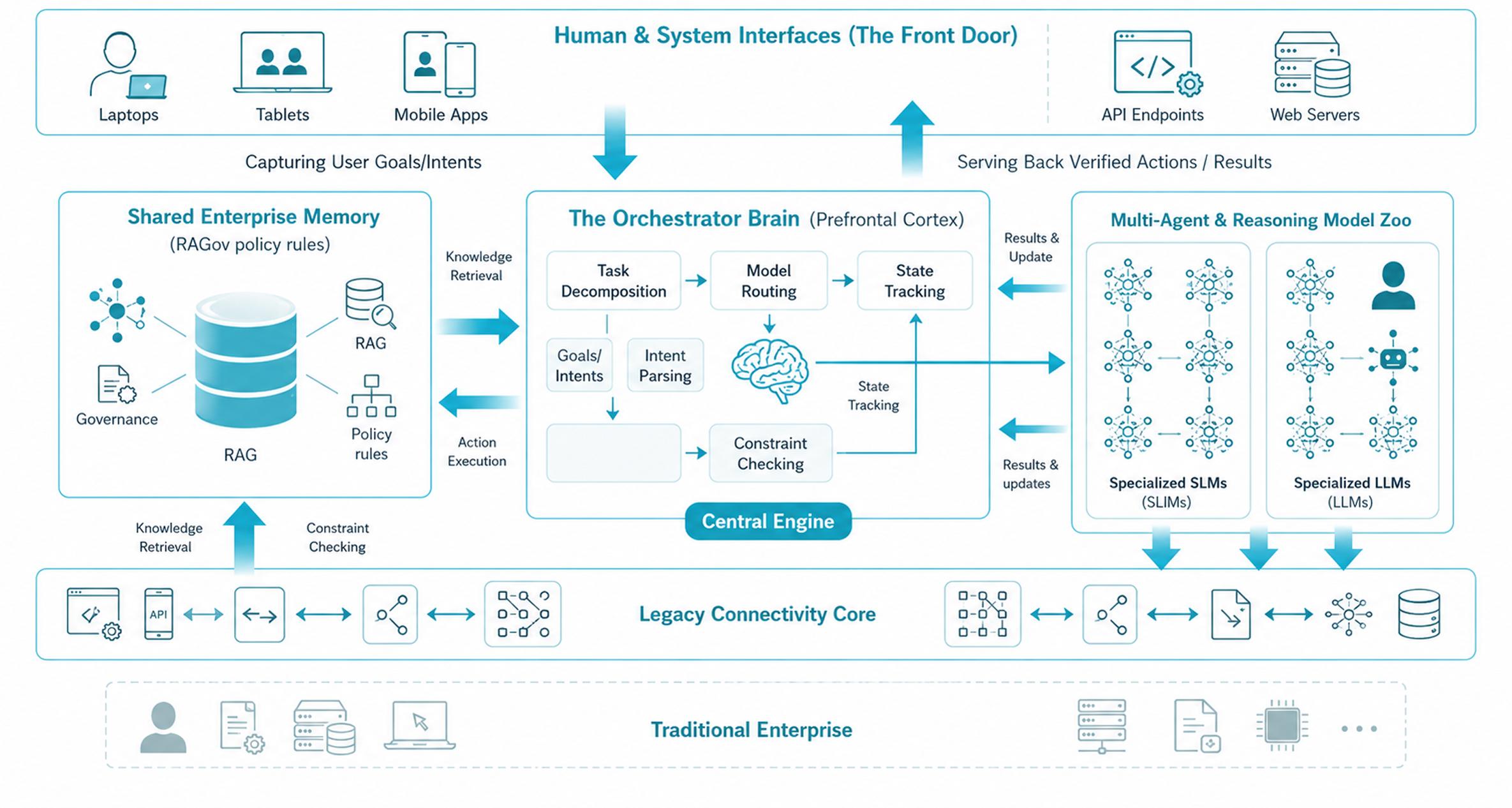
mroads SYNAPSE -INTELLIGENT COGNITIVE CONTENT ARCHITECTURE
Why Hospitality Was the Right Stress Test
The origins of this architecture were shaped by real operational complexity in the hospitality sector.
Hospitality is a useful proving ground because it combines centralized brand control with highly distributed execution. A global hospitality brand may have corporate marketing teams, regional business units, property managers, franchise operators, loyalty programs, partner channels, and multiple customer-facing digital touchpoints.
A single campaign can require hundreds or thousands of localized content variations. Each variation may need to respect brand standards, regional regulations, property-level details, language requirements, channel formats, image rights, campaign timing, and approval workflows.
The business impact is immediate. A broken digital experience does not merely create an internal process issue. It can affect bookings, guest confidence, franchise relationships, loyalty engagement, and brand reputation.
This environment exposed a clear architectural reality:
Enterprise content and operational decisions are distributed, but governance, visibility, and intelligence need to be unified.
That insight became foundational to the Synapse approach.
The Core Architectural Principle: Abstract the Platforms, Orchestrate the Work
Synapse is built around a simple but powerful principle:
Do not force every enterprise platform to become intelligent. Instead, create an intelligent orchestration layer that coordinates existing platforms.
This allows enterprises to avoid risky rip-and-replace modernization. AEM can remain the content source. DAM platforms can remain asset repositories. BPM can remain the policy and approval engine. CRM can remain the customer intelligence layer. Analytics tools can remain the reporting layer.
Synapse sits above these systems and coordinates the logic of execution.
Synapse Is | Synapse Is Not |
|---|---|
An AI-enabled orchestration layer | A replacement for AEM, DAM, BPM, or CRM |
An enterprise control plane | A new system of record |
A coordination layer for content, assets, workflows, and policies | A standalone content management platform |
A model and agent routing framework | A generic chatbot interface |
A governance-aware execution layer | A one-time integration project |
A feedback-driven architecture | An uncontrolled self-learning system |
This distinction is important for enterprise adoption. Most organizations cannot afford to discard their existing systems. They need an architecture that improves coordination without destabilizing the platforms that already run the business.
The Five Pillars of AI Enterprise Orchestration
A mature AI orchestration layer requires more than a language model or an automation script. It needs a structured architecture that connects intent, context, governance, execution, and learning.
mroads Synapse can be understood through five architectural pillars.
Pillar | What It Does | Why It Matters |
|---|---|---|
Intent Layer | Captures business goals from users, APIs, systems, or operational triggers | Converts human and system requests into structured work |
Semantic Memory Layer | Stores metadata, policies, content history, asset relationships, and execution context | Gives the orchestration layer enterprise-specific understanding |
Orchestration Layer | Decomposes tasks, assigns work, selects models, routes actions, and coordinates systems | Replaces brittle manual coordination with intelligent workflow execution |
Governance Layer | Enforces approval rules, brand standards, compliance requirements, access controls, and human review | Makes AI-assisted execution safe for enterprise operations |
Execution Layer | Publishes content, updates systems, triggers workflows, monitors outcomes, and logs results | Turns decisions into verified enterprise action |
Together, these pillars create a practical architecture for AI-ready enterprise operations.
Inside the Synapse Reference Architecture
At a high level, Synapse consists of six major architectural components.
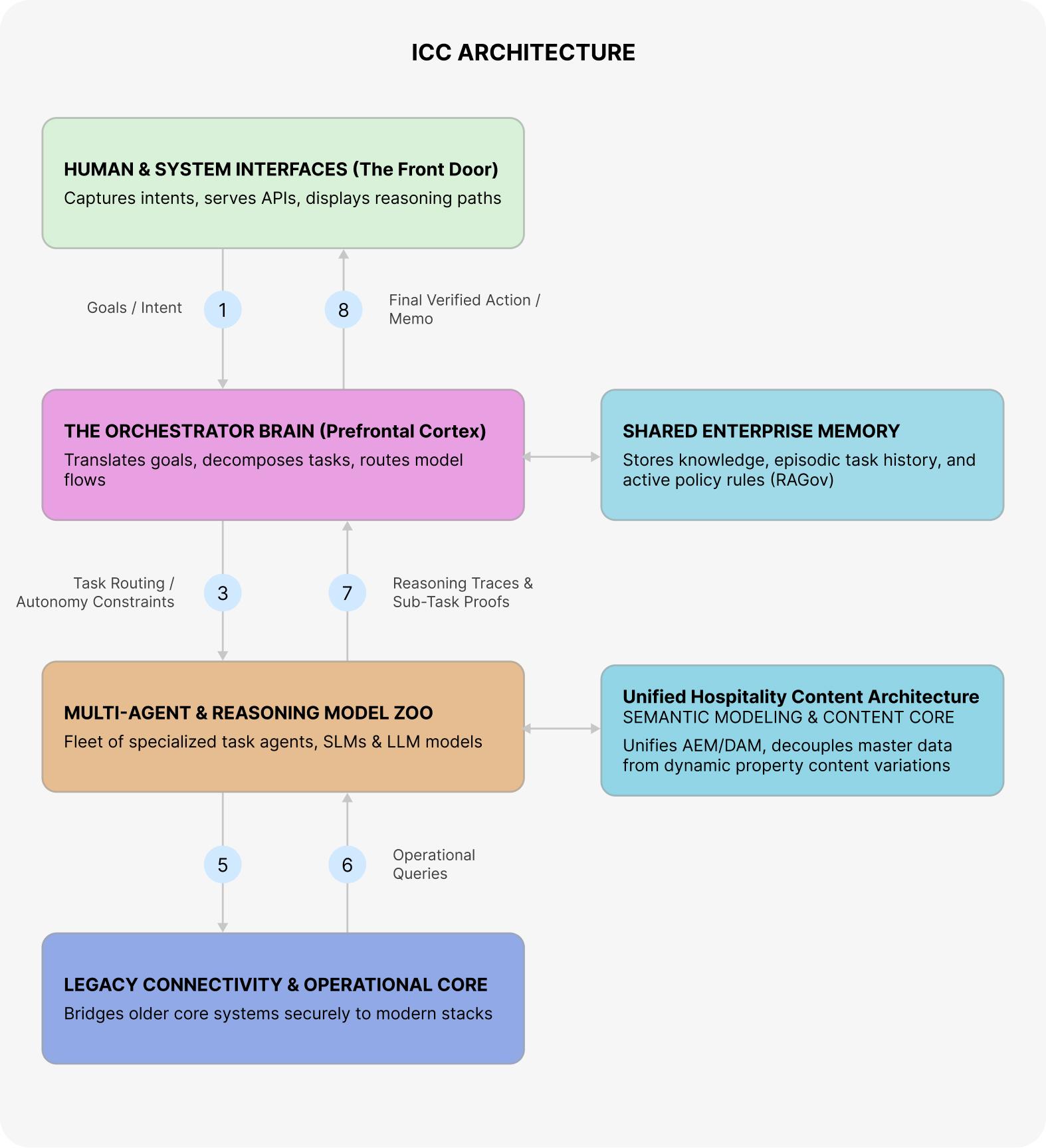
The front door is where enterprise intent enters the system. This could be a business user requesting a campaign, a regional team initiating a content variation, an API sending an operational trigger, or a downstream system requesting an update.
For example: "Launch the summer promotional campaign across all regional properties."
This request may sound simple, but it contains multiple hidden tasks: identify target properties, retrieve approved assets, generate localized variations, check brand rules, route approvals, publish to channels, and monitor execution.
The front door converts the request into a structured input for orchestration.
The shared enterprise memory layer gives the system organizational context.
It can include:
- Brand rules
- Regional guidelines
- Property metadata
- Asset history
- Campaign history
- Approval patterns
- Policy rules
- Content relationships
- Previous execution outcomes
- Exception history
This memory layer is essential because enterprise AI cannot operate only on generic intelligence. It needs enterprise-specific context.
A model may understand how to create campaign copy, but it does not automatically know which properties are included in a region, which image rights apply, which approval rules are active, or which channel formats are required. Shared enterprise memory provides that context.
The orchestrator is the decision and routing layer.
It decomposes broad goals into smaller tasks, determines dependencies, identifies required context, selects the appropriate model or workflow, and coordinates the sequence of execution.
For example, the orchestrator may determine that:
Asset tagging can be handled by a specialized small language model.
Localized copy generation requires a larger language model with brand context.
Legal review requires BPM routing.
Image format conversion should be handled by an automation service.
Final publishing requires API execution through AEM and downstream channel systems.
Exceptions should be escalated to a human reviewer.
This is the point where Synapse moves beyond simple automation. It does not just execute a predefined script. It reasons through the structure of work and routes tasks to the right execution path.
Not every task requires the same level of intelligence.
One of the strongest architectural ideas in Synapse is the ability to route work across specialized agents, small language models, larger language models, deterministic rules, and traditional workflow systems.
This has practical enterprise value.
A high-volume formatting task should not require an expensive general-purpose model. A compliance-sensitive task should not be executed without policy checks. A creative generation task may need a larger model, but a metadata normalization task may be better handled by a specialized agent or rules engine.
Task Type | Best Execution Path | Reason |
|---|---|---|
Alt-text generation | Specialized model or agent | Fast, repeatable, low-complexity task |
Asset tagging | Small language model with metadata rules | Requires context but not deep reasoning |
Regional content adaptation | Larger language model with brand and region context | Requires language, tone, localization, and policy awareness |
Approval routing | BPM workflow | Requires deterministic governance and auditability |
Channel formatting | Automation service or rules engine | Requires precision and repeatability |
Compliance review | Policy engine plus human review where needed | Requires control, traceability, and accountability |
Gap analysis across channels | Reasoning model plus analytics context | Requires comparison, interpretation, and prioritization |
This routing model improves cost efficiency, performance, reliability, and governance.
In many enterprise AI discussions, governance is treated as an afterthought. In Synapse, governance is part of the architecture.
The system does not replace proven BPM environments. Instead, it uses them as policy guardians.
This is important because enterprise workflows often require formal approvals, service-level commitments, legal checks, brand compliance, regional constraints, and audit trails. AI can assist the process, but it cannot be allowed to bypass enterprise controls.
BPM guardrails ensure that AI-generated or AI-routed work still passes through the appropriate governance pathways.
The connectivity core links Synapse to enterprise systems without forcing every platform into a brittle point-to-point dependency model.
This layer can include API adapters, reusable connectors, webhooks, message queues, event streams, metadata mapping, and integration services.
Instead of creating custom logic for every workflow between every system, the connectivity core provides a more sustainable pattern for enterprise integration.
The Automation Pipeline: From Intent to Verified Action
Synapse operates through a structured automation pipeline that turns a high-level business goal into a monitored enterprise action.
A user, system, or API submits a goal. The request may be phrased as a business objective, not a technical instruction.
Example: "Launch the regional summer campaign across all eligible properties."
Synapse retrieves relevant context from shared enterprise memory. This may include brand rules, property metadata, asset history, regional policies, language requirements, approval rules, and previous campaign data.
The orchestrator breaks the broad goal into smaller tasks.
For example:
- Identify eligible properties
- Retrieve approved campaign assets
- Generate regional variations
- Validate metadata
- Check brand compliance
- Route for regional approval
- Publish to digital endpoints
- Monitor completion and exceptions
Each task is routed to the right execution path. Some tasks may go to specialized agents, some to small language models, some to larger reasoning models, and some to deterministic workflow systems.
Before outputs move downstream, Synapse checks them against active policies, brand rules, regulatory requirements, regional constraints, and approval workflows.
When a task requires judgment, approval, or escalation, the system routes it to the appropriate human stakeholder. This ensures that AI supports enterprise work without removing accountability.
Verified actions are executed through the appropriate systems. Content may be published through AEM. Assets may be updated in DAM. Approvals may be recorded in BPM. Campaign data may be synchronized with CRM or analytics systems.
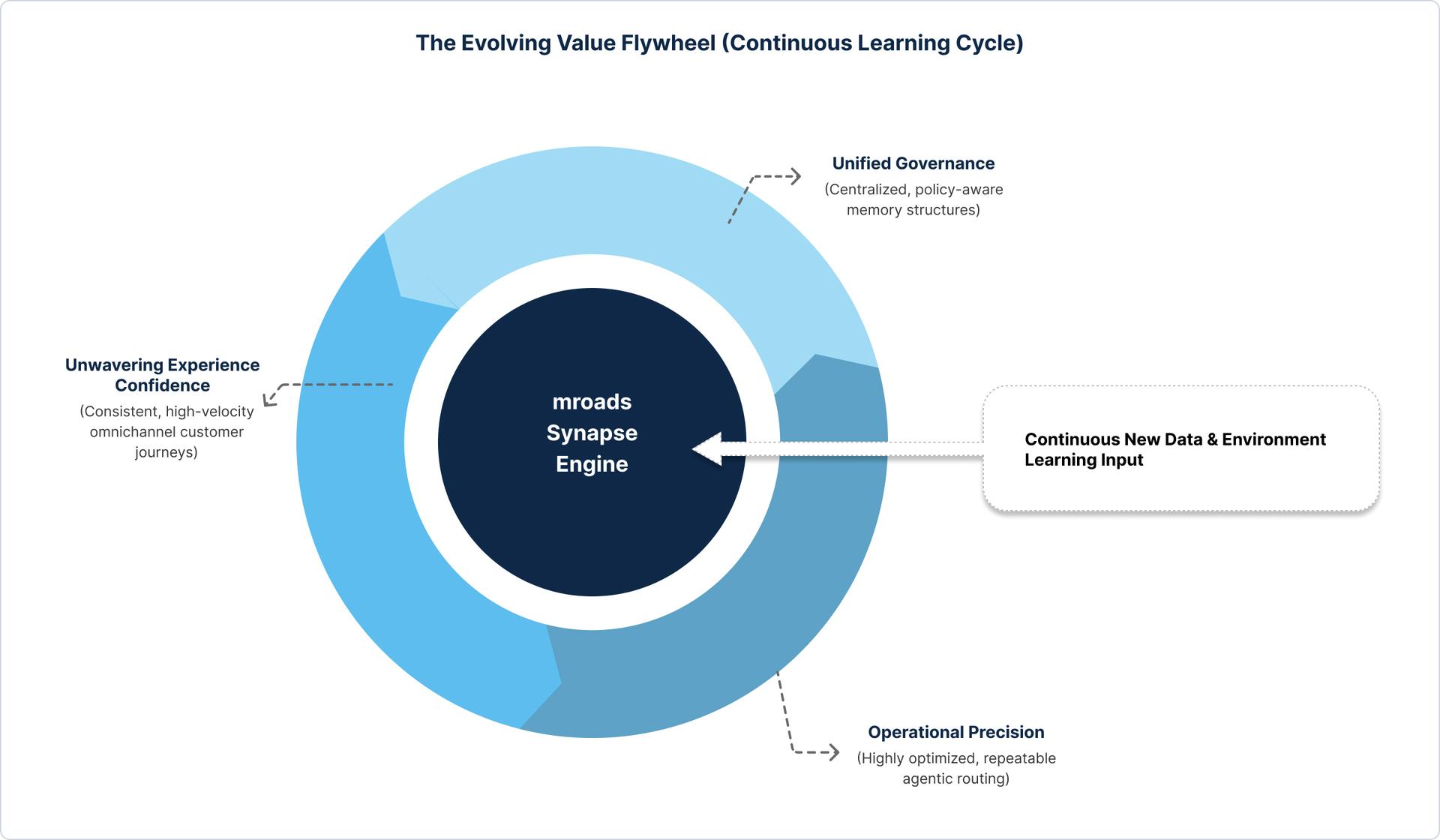
Execution results are monitored and logged. Exceptions, delays, approvals, rejections, and performance signals are fed back into the system to improve future routing and operational insight.
Governance, Security, and Observability in AI-Orchestrated Enterprises
For AI orchestration to work in an enterprise environment, intelligence must be paired with control.
Synapse should not be understood as an uncontrolled AI layer making independent decisions across critical systems. It is better understood as a governed orchestration framework where every action can be routed, checked, approved, logged, and monitored.
Governance Area | Architectural Requirement |
|---|---|
Identity and access | Users, systems, and agents must operate within approved permissions |
Role-based routing | Tasks should be routed based on role, region, function, and authority |
Policy enforcement | Brand, legal, regional, and operational rules must be applied before execution |
Human-in-the-loop controls | Sensitive decisions should require review or approval |
Audit trails | Every action, approval, exception, and execution event should be traceable |
Model decision visibility | AI-assisted outputs should include reasoning signals, confidence levels, or validation markers where appropriate |
Content provenance | Teams should be able to trace which assets, rules, and data were used |
Exception handling | Failed, ambiguous, or high-risk workflows should be routed for intervention |
Rollback readiness | Publishing and execution workflows should include recovery pathways |
Continuous monitoring | Operational signals should be captured to improve governance and performance |
This is where enterprise AI architecture must be different from consumer AI experiences. In the enterprise, the question is not only "Can AI generate an output?" The question is "Can the organization trust, govern, trace, and operationalize that output?"
A More Sustainable Integration Model
The long-term value of an AI orchestration layer is not limited to individual workflow acceleration. It changes the economics of enterprise integration.
Point-to-point integrations create cumulative complexity. Every new workflow adds more custom logic. Every new platform increases the number of dependencies. Every API change introduces regression risk.
Rather than embedding business logic inside each connection, Synapse abstracts workflow intelligence into a centralized control plane. Systems remain connected, but the logic of coordination becomes easier to manage, update, observe, and scale.
Dimension | Legacy Point-to-Point Integration | AI-Orchestrated Enterprise Architecture |
|---|---|---|
System dependency | High | Lower through abstraction |
Workflow visibility | Fragmented | Centralized across the orchestration layer |
Change management | Expensive and brittle | More modular and configurable |
Governance | Distributed across systems and teams | Enforced through policy-aware orchestration |
AI readiness | Limited | Built into task routing, model selection, and feedback loops |
Regional adaptability | Manual and inconsistent | Context-aware and policy-driven |
Maintenance burden | Increases with each new connection | Reduced through reusable connectors and orchestration patterns |
Business agility | Slowed by integration complexity | Improved through intent-driven execution |
Business Impact: From Operational Drag to Intelligent Execution
The value of AI orchestration should be measured in practical enterprise outcomes, not abstract AI promise.
In orchestration-led modernization programs, organizations can target measurable improvements in several areas.
By reducing custom connector maintenance and standardizing regression pathways across platforms such as AEM, DAM, BPM, and CRM, enterprises can reduce the effort required to maintain complex integration landscapes. A realistic near-term target is a 10% to 15% reduction in IT integration and QA overhead where workflows are repetitive, integration-heavy, and currently dependent on manual coordination.
When asset lookup, content variation, approval routing, policy validation, and publishing workflows are orchestrated rather than handled through ad-hoc coordination, the same teams can move faster without replacing existing platforms. A 15% to 25% improvement in first-year process velocity is achievable in environments where high-volume workflows are standardized and routed through intelligent orchestration.
Creative, marketing, operations, and IT teams spend less time searching for assets, chasing approvals, reconciling metadata, manually coordinating exceptions, and maintaining brittle integrations. This frees teams to focus on higher-value work.
Because the orchestration layer captures workflow signals across systems, leadership gains a clearer view of execution status, approval bottlenecks, asset usage, exception patterns, and process performance.
Enterprises can extend the value of existing systems instead of replacing them. AEM, DAM, BPM, CRM, analytics, and regional portals continue to operate, but they become part of a more intelligent and coordinated architecture.
From Content Orchestration to Enterprise Orchestration
Although Synapse was shaped by hospitality content and digital experience complexity, the underlying architecture applies to many content-heavy and workflow-heavy industries.
Any enterprise that operates across distributed systems, regional teams, compliance rules, approval workflows, digital channels, and asset-heavy processes can benefit from an AI orchestration layer.
Relevant sectors include:
Industry | Orchestration Challenge |
|---|---|
Hospitality | Regional campaigns, property-level content, brand governance, booking journeys |
Retail | Product content, promotions, localization, inventory-linked experiences |
Financial services | Compliance-heavy communications, approvals, customer segmentation |
Healthcare | Policy-controlled content, regional operations, regulated workflows |
Manufacturing | Dealer portals, product documentation, partner communications |
Media and entertainment | Asset reuse, rights management, multi-channel publishing |
Travel and transportation | Location-based content, partner channels, real-time operational updates |
The broader opportunity is to move from isolated application modernization to enterprise workflow intelligence.
The Strategic Horizon: Toward Adaptive Enterprise Operations
The next generation of enterprise architecture will not be defined only by cloud migration, SaaS adoption, or API connectivity. Those investments matter, but they do not automatically create intelligent operations.
That is the role of Synapse.
It gives enterprises a way to keep their existing platforms while creating a more adaptive operational model. It allows business intent to move through the organization with context, governance, intelligence, and traceability. It helps fragmented systems work together without forcing every platform to become the center of the enterprise.
The result is not just faster automation. It is a more coherent enterprise architecture.
Conclusion
Enterprises do not need another isolated application competing for attention inside an already crowded technology stack.
They need an intelligent control plane that can sit above existing systems, understand business intent, coordinate execution, enforce governance, and continuously improve through operational feedback.
mroads Synapse represents this architectural shift: from fragmented platforms and brittle integrations to AI-enabled enterprise orchestration.
For organizations facing content complexity, regional operational variation, approval bottlenecks, integration overhead, and growing pressure to adopt AI safely, the path forward is not to replace every system.

Quality Engineering Team