Enterprise software quality is no longer a final checkpoint before release. It has become a business-critical discipline that influences revenue continuity, customer trust, operational resilience, and release velocity.
A failed transaction flow can affect revenue. A latency spike in a core service can degrade customer experience. A synchronization issue between systems can create operational disruption. A defect in a digital workflow can quickly move beyond a technical issue and become a business risk.
This is why traditional QA, while still necessary, is no longer sufficient on its own.
Modern enterprise platforms are highly connected. Applications interact with APIs, cloud services, databases, third-party platforms, legacy systems, security layers, analytics tools, and increasingly, AI models. Each component may function independently, but the business outcome depends on the reliability of the full ecosystem.
Quality, therefore, must be approached systemically. At mroads, we call this approach engineered assurance.
Engineered assurance is a Quality Engineering model that connects business outcomes, application architecture, automation, data validation, AI-assisted intelligence, human governance, and release visibility into a unified operating approach. It is designed to help enterprises move faster while maintaining control over risk, reliability, and customer experience.
It shifts quality from a downstream validation activity to an architecture of confidence.
Why Enterprise Quality Needs a New Operating Model
For many organizations, the quality landscape has become increasingly fragmented.
Testing may be managed in one tool. Defects may be tracked in another. Automation results may sit in a separate framework. Logs, traces, performance data, security findings, and production signals may be distributed across multiple platforms and teams. AI-driven features may introduce additional evaluation needs that do not fit neatly into traditional pass/fail testing.
The result is often a high volume of quality data without a unified view of quality risk.
This creates pressure across the delivery lifecycle. Releases slow down when validation cannot keep pace with engineering velocity. Automation expands, but confidence may not improve if scripts become brittle or difficult to maintain. Leadership receives more reports, but still lacks clear insight into business readiness, system exposure, and release confidence.
These challenges are not only process-related. They reflect a deeper need for quality to be structured as an integrated operating model. Engineered assurance addresses this need by aligning quality activities with business impact, system dependencies, automation strategy, governance, and decision-ready telemetry.
Quality Must Be Connected to Business Outcomes
The first principle of engineered assurance is that quality should begin with the business outcomes the system is expected to protect.
A defect does not carry the same weight in every context. A minor display issue on a low-impact screen is different from a failure that blocks transactions, disrupts fulfillment, compromises data accuracy, exposes security risk, or damages customer trust.
Traditional QA often reports activity-based indicators such as test execution status, defect counts, pass percentages, and automation coverage. These indicators have value, but they do not always explain whether the business is protected.
Engineered assurance extends the measurement model. It focuses on the stability of business-critical workflows, the reliability of integrations, the readiness of core services, the resilience of infrastructure, the security of sensitive flows, and the trustworthiness of AI-enabled capabilities. Instead of validating every area with the same level of intensity, teams can focus assurance efforts on the workflows and dependencies that matter most to business continuity, customer experience, and release confidence.
System Understanding Must Precede Test Execution
Enterprise failures rarely remain confined to a single application layer.
A customer-facing issue may appear on a web or mobile interface, but the underlying cause may be an API contract change, a delayed event queue, a stale cache, a database lock, a legacy system timeout, a cloud scaling constraint, or an identity service issue.
This is why the mroads approach places strong emphasis on application topology. Before test design can be meaningful, teams must understand how business workflows move across the technology ecosystem — user interfaces, services, messages, data flows, infrastructure boundaries, third-party dependencies, security touchpoints, and AI model interactions.
Topology gives quality work context. It helps teams understand what a change may affect, which dependencies are involved, where regression should be prioritized, and how failures can propagate across the system. It also helps automation become more resilient because test assets are aligned to business pathways rather than isolated screens or components. This is the same principle that underpins our layered validation model — testing the edge experience, service and messaging layer, data and state layer, and infrastructure together, rather than as separate silos.
In complex enterprise environments, quality cannot depend only on what is visible at the surface. It must be grounded in how the system actually operates.
Automation Must Be Governed by Architecture
Automation remains central to modern Quality Engineering. However, automation without structure can create its own form of risk.
Many organizations build large automated test suites and later discover that the suites are expensive to maintain. Interface changes break multiple scripts. Test data becomes unreliable. Environment instability creates false failures. Third-party changes invalidate assumptions. Over time, teams spend more effort maintaining automation than improving assurance.
This is the automation illusion
The assumption that more automated tests automatically create more confidence.
The mroads approach treats automation as an engineering asset, not a volume metric. Every automated flow should have a clear purpose — protect a business-critical workflow, validate a dependency, reduce a known risk, or produce a meaningful release signal. When automation is connected to topology and business impact, it becomes easier to maintain, easier to interpret, and more useful to decision-making.
The objective is not simply to increase the number of scripts. The objective is to build automation that supports durable, explainable, and business-aligned assurance — which is why our self-healing automation frameworks are built to reduce script maintenance and flaky failures as a first-class design goal, not a side effect.
AI Can Accelerate Assurance When Paired With Human Governance
AI is becoming an important accelerator for Quality Engineering. It can help analyze requirements, logs, traces, defects, test results, production signals, and system documentation. It can identify change impact, suggest regression paths, summarize failure clusters, recommend candidate test flows, and support the ongoing maintenance of quality knowledge.
This matters because enterprise systems generate more information than human teams can manually interpret at speed.
However, AI should not operate without governance. A generated test scenario may be technically plausible but commercially irrelevant. A recommended flow may miss operational nuance. A model may identify patterns without understanding the business consequences behind them. In high-impact enterprise environments, assurance must remain accountable to human judgment.
The mroads approach uses AI as an accelerator within a governed model — the same three-layer structure that anchors our Agentic Framework: AI-assisted workflows for speed, a connected engineering ecosystem for integration, and human and enterprise governance for accountability. Human QE architects, product owners, domain experts, and security stakeholders remain responsible for validating relevance, risk, compliance, edge cases, and release implications. Every AI suggestion is reviewed by a qualified engineer; every script change or data action requires approval; every action is logged for audit and traceability.
AI improves the reach of Quality Engineering. Human oversight protects its judgment.
Introducing the Quality Command Center
As enterprise systems become more connected, quality leaders need a clearer operating view of system readiness. This is where the Quality Command Center (QCC) fits naturally into the engineered assurance model.
QCC is not simply a dashboard of test results. It is a way of organizing quality signals across a complex technology ecosystem so that teams can understand risk, coverage, dependencies, reliability, and release readiness in one coherent view.
A release is not safe because a feature has passed testing in isolation. Confidence comes from understanding how the full pathway behaves across user experience, services, data, infrastructure, security, AI models, and operational dependencies. QCC brings these assurance signals together — release readiness scoring, automation coverage by test level, defect summaries, environment health, and a release risk heatmap — so teams can see where the system is stable, where exposure remains, which dependencies require attention, and whether release decisions are supported by evidence.
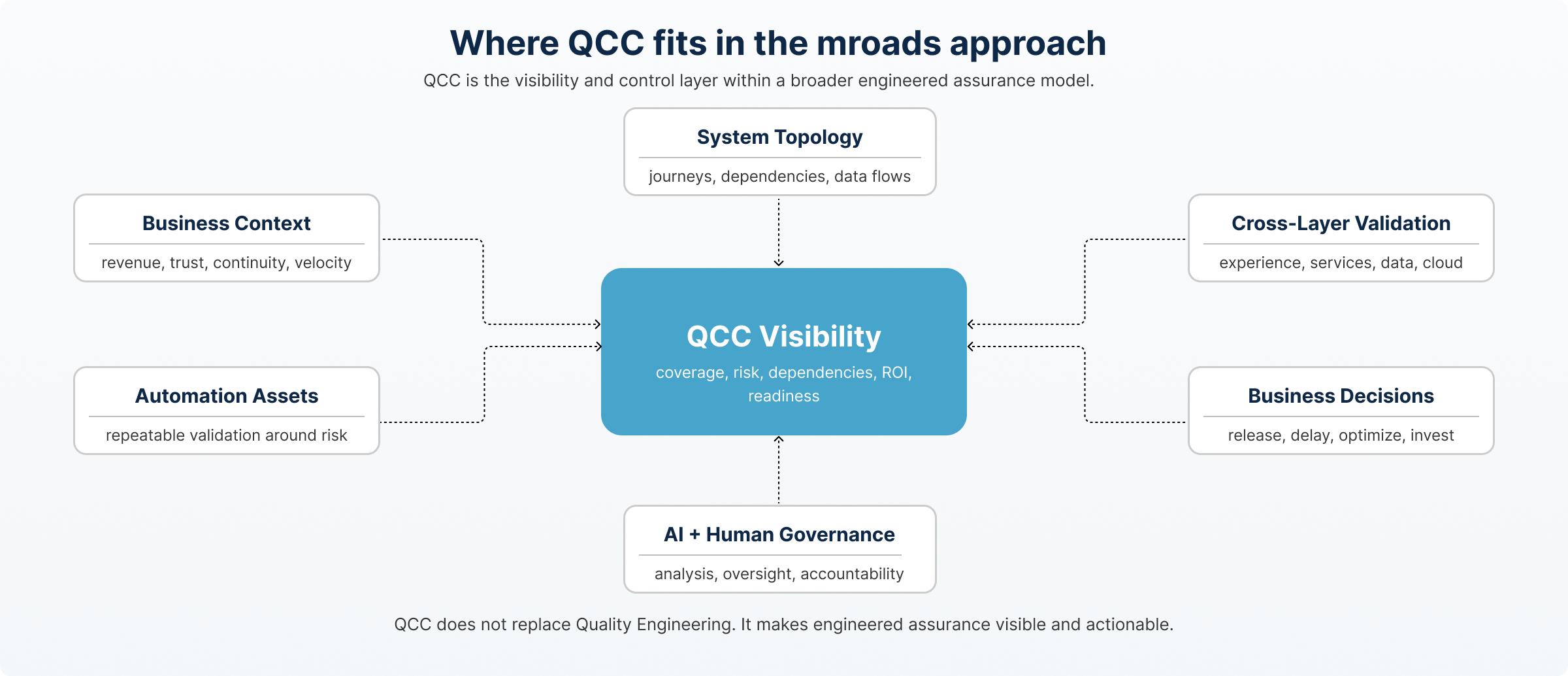
Within the broader mroads approach, QCC serves as the visibility and control layer of engineered assurance. It does not replace the underlying Quality Engineering discipline. It makes that discipline measurable, transparent, and actionable.
A Connected Model for Systemic Quality
The mroads approach to engineered assurance follows a connected progression:
Business context defines what quality must protect. System topology reveals how critical workflows move through the technology ecosystem. Cross-layer validation confirms whether those workflows behave reliably under real conditions. Automation, structured through our accelerator library, provides repeatable assurance around high-value areas. AI-assisted intelligence, governed through the Agentic Framework, accelerates analysis and maintenance. Human governance keeps the model aligned with business risk. QCC visibility translates quality signals into release confidence.
This is the foundation of systemic quality. It is not a single tool, report, framework, or testing method. It is an operating model that connects the work of quality to the realities of enterprise delivery — the same operating model, applied to hospitality's specific systems, that runs through our approach to PMS, loyalty, payments, and distribution platforms.
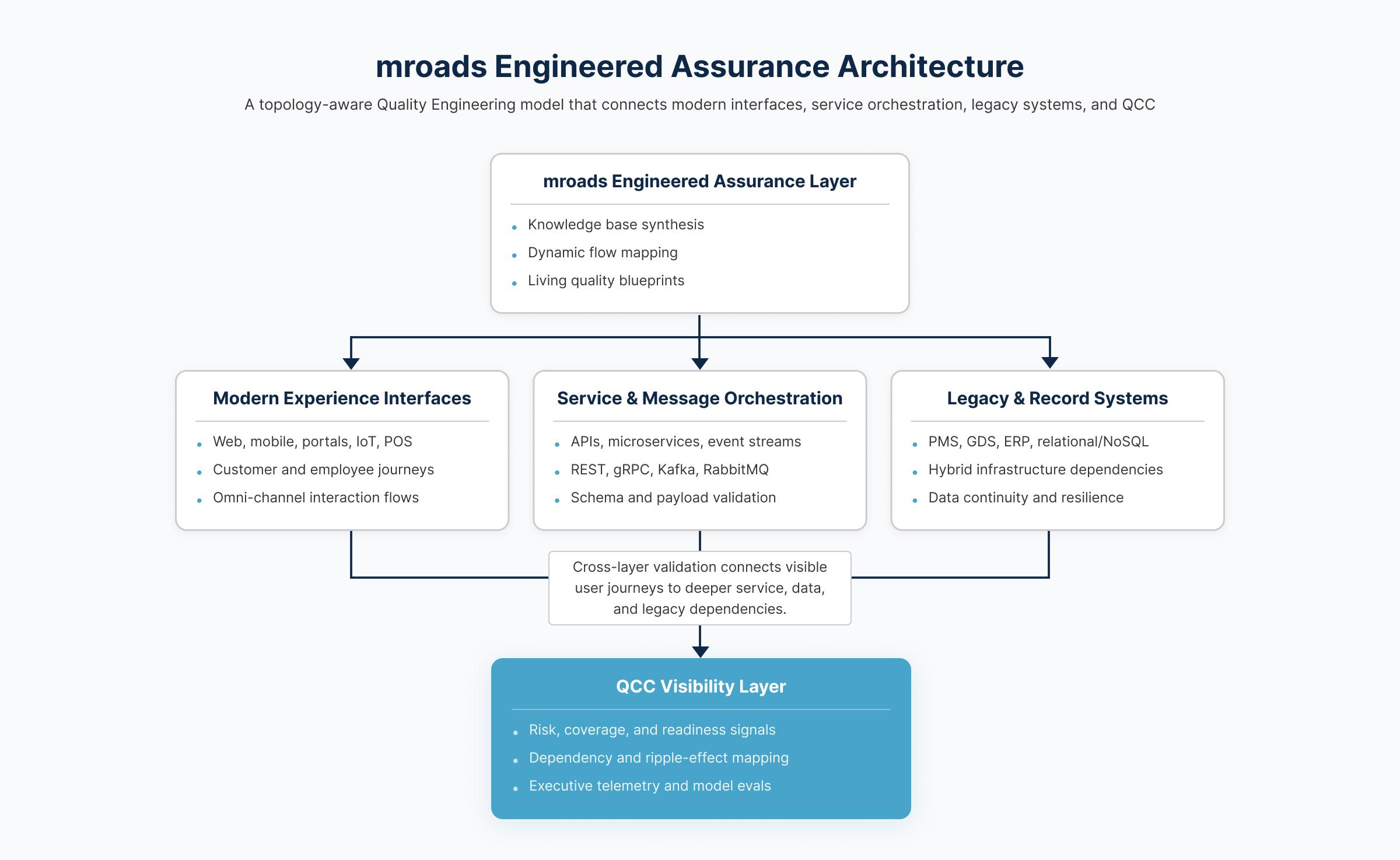
Cross-layer validation connects visible user journeys to deeper service, data, and legacy dependencies — with knowledge-base synthesis, dynamic flow mapping, and living quality blueprints sitting underneath as the connective layer that keeps this model current as systems evolve.
What Changes for Enterprise Leaders
Engineered assurance changes the quality conversation at the leadership level. It moves quality away from late-stage reporting and toward continuous release confidence. It helps technology leaders understand system readiness, product leaders assess customer journey risk, engineering teams trace failures across dependencies, and business leaders make decisions with stronger evidence.
The value is not limited to faster testing. The broader value is a more reliable way to manage digital risk.
With a systemic quality model, enterprises can reduce late-cycle surprises, prioritize validation around business impact, improve automation return, identify dependency risks earlier, govern AI-enabled features more responsibly, and bring greater clarity to release decisions. This is especially important as enterprise systems become more distributed, multi-vendor, cloud-enabled, and AI-assisted. Quality must evolve with that complexity.
The mroads Approach
At mroads, engineered assurance is built on the belief that quality should be designed into how enterprise systems are understood, validated, automated, monitored, and governed.
We do not view QA as only a downstream checkpoint or a collection of disconnected testing activities. We see it as a discipline that should help enterprises protect revenue, customer trust, brand reputation, operational stability, and release timelines.
The Quality Command Center is one expression of this approach — it gives teams and leaders a clearer view of quality across complex systems. But the larger shift is systemic:
Quality must be connected to business outcomes.
It must be informed by system architecture.
It must validate across layers.
It must use automation with discipline.
It must apply AI with guardrails.
It must produce signals that leaders can act on.
That is the mroads approach to engineered assurance.
Conclusion
Enterprise technology is becoming more connected, more dynamic, and more dependent on software quality.
Traditional QA practices remain important, but they cannot carry the full burden alone. Static reports, isolated test execution, and disconnected automation are not enough for systems that operate across many applications, services, data flows, infrastructure layers, vendors, and AI models.
The next step is systemic quality. Engineered assurance gives enterprises a practical way to understand risk, validate business-critical workflows, govern automation and AI, and convert quality signals into release confidence.
In this model, quality is not a checkpoint at the end of delivery. It is part of how the business moves with greater reliability, speed, and control.

Quality Engineering Team