In hospitality technology, a glitch is rarely just a bug.
A broken workflow can quickly become a revenue issue, an operational disruption, or a guest experience failure. When a booking engine shows the wrong availability, when a pricing rule misfires during a high-demand weekend, when loyalty discounts do not apply correctly, or when inventory fails to synchronize across systems, the impact is immediate. Guests lose confidence. Operators lose trust. Revenue teams lose control.
This is why traditional QA is no longer enough for modern hospitality platforms.
Hospitality organizations are now running increasingly complex digital ecosystems. Booking engines, property management systems, CRM tools, loyalty engines, mobile apps, distribution channels, payment systems, revenue management platforms, and AI-driven recommendation engines all need to work together. The guest may only see a simple booking flow or mobile check-in screen, but behind that experience is a chain of systems that must stay synchronized in real time.
The challenge is not simply testing whether a page loads or whether a feature works in isolation. The real question is whether the platform behaves as a coherent business engine under real commercial conditions.
That requires a shift from conventional QA to engineered assurance.
When Hospitality Systems Fail, the Business Feels It Immediately
Consider a large hotel brand launching a new dynamic demand optimization platform.
On paper, the system is elegant. It ingests signals from room cancellations, local event calendars, mobile search activity, booking trends, loyalty behavior, and inventory changes. It then uses those signals to trigger AI-assisted pricing and availability adjustments across channels.
When the workflow works, the business benefits. Revenue teams can respond faster to demand. Property teams can optimize inventory. Guests receive more relevant offers.
But when the chain breaks, the consequences are significant. A synchronization drop between the inventory service and a booking system may lead to incorrect availability. A pricing rule may be applied to the wrong segment. A promotion may appear on one channel but not another. A loyalty offer may conflict with a revenue management rule.
These are not minor software defects. They are business failures expressed through software. That is what makes hospitality quality engineering uniquely demanding. The systems are not only technical. They are operational, commercial, and experiential.
The Velocity Gap in Hospitality QA
Many hospitality technology teams are under pressure to release faster. Business leaders want new digital experiences, smarter pricing, more personalized offers, better mobile journeys, faster integrations, and more responsive guest services.
At the same time, the underlying technology landscape is becoming harder to test. Every new capability introduces more dependencies. A simple feature may touch the booking engine, PMS, CRM, loyalty platform, payments layer, and distribution channels. AI-driven workflows add another layer of complexity because outputs depend on data quality, signal timing, model behavior, and business rules working together.
This creates what we call the Velocity Gap: the business wants speed, the technology landscape demands caution, and traditional QA often sits in the middle, trying to protect quality through manual effort, late-stage regression, and test scripts designed for a less connected world.
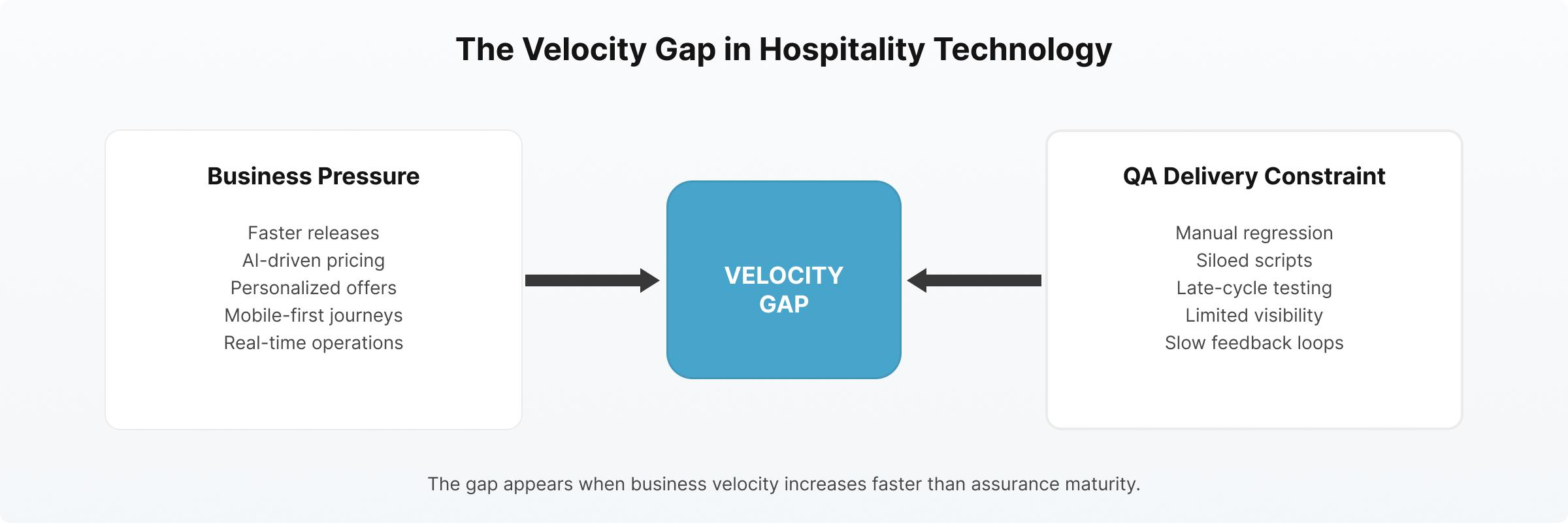
Business Need | Traditional QA Constraint |
|---|---|
Faster releases | Long regression cycles |
More frequent updates | Manual test execution bottlenecks |
Personalized guest experiences | Complex test data requirements |
AI-driven pricing and offers | Hard-to-predict system behavior |
Integrated workflows | Incomplete end-to-end validation |
Operational confidence | Limited visibility into real business risk |
In some release environments, manual regression and repetitive validation can consume a significant share of the release window, especially where automation coverage is limited and systems are highly integrated. Teams add more testers, extend test cycles, or increase script execution volume, but that does not always translate into better assurance. More testing activity does not automatically create more confidence — which is exactly why our own delivery model is built around reusable automation and reduced manual dependency rather than headcount, targeting 15% year-over-year efficiency gains rather than more hours worked.
Why Traditional QA Misses Systemic Risk
Traditional QA was designed around a relatively straightforward question: Does the application behave according to the expected requirement?
That question is still important, but it is no longer sufficient. In hospitality, risk often lives between systems, not inside a single screen. The issue may not be that the booking page fails. The issue may be that the booking page shows data that is slightly out of sync with inventory. These failures are subtle because each individual system may appear to be functioning correctly. The defect appears only when the full business workflow is tested end to end.
Traditional QA tends to focus on screens, happy paths, manual regression scripts, known defect areas, and late-cycle validation. Modern hospitality platforms need more: assurance around data movement, integration behavior, business rule consistency, performance under demand, and production readiness.
From QA to Engineered Assurance
Engineered assurance is a more systematic approach to quality. It treats quality not as a final testing phase, but as a business control designed into the delivery lifecycle.
Traditional QA asks: Did the feature work during testing? Engineered assurance asks: Is this business workflow reliable enough to operate under real hospitality conditions?
Traditional QA | Engineered Assurance |
|---|---|
Tests features after development | Designs quality into the delivery lifecycle |
Relies heavily on manual scripts | Uses automation, telemetry, risk models, and workflow validation |
Focuses on whether test cases passed | Focuses on release confidence and operational readiness |
Validates expected behavior | Validates system behavior under real business conditions |
Works late in the cycle | Starts with requirements, architecture, integrations, and risk mapping |
Measures defects | Measures reliability, resilience, business impact, and release risk |
Scales by adding more people | Scales through automation, intelligence, and reusable quality assets |
This does not mean manual testing disappears. Human judgment remains important, especially for exploratory testing, guest experience review, and complex business scenarios. But manual testing should not be the foundation of release confidence. It should be one part of a broader engineered assurance model.
At mroads, that model isn't a single tool — it's four connected capabilities working together:
- The Agentic Framework, which governs how AI accelerates discovery, test generation, and defect triage under human review.
- Layered validation, which tests the guest journey across Edge & Experience, Services & Messaging, Persistence & State, and Infrastructure & Performance rather than one screen at a time.
- The Quality Command Center (QCC), which turns all of that telemetry into a single, evidence-based release-readiness view.
- The 7-Dimension QA Scorecard, which ties every one of those signals back to business outcomes — revenue, guest experience, integration health, resilience, cost, and security.
Engineered assurance is what happens when these four work as one system instead of four separate initiatives.
What Engineered Assurance Looks Like in Hospitality
For hospitality leaders, engineered assurance means validating the workflows that protect revenue, guest trust, and operational continuity — testing beyond the interface.
A guest journey may begin on a mobile app, move through a booking engine, trigger availability checks, apply loyalty rules, process payment, update the PMS, and sync with downstream operational tools. Each step needs to be tested, but more importantly, the relationships between the steps need to be validated.
Workflow | Quality Risk | Assurance Focus |
|---|---|---|
Booking engine to inventory sync | Overselling, incorrect availability, failed reservations | End-to-end data validation and synchronization checks |
Dynamic pricing | Incorrect rates, margin leakage, guest dissatisfaction | Business rule testing, demand simulation, and pricing validation |
Loyalty offers | Wrong discounts, eligibility errors, inconsistent guest experience | Segment validation, offer logic testing, and CRM integration checks |
Mobile check-in | Guest friction, operational escalation, failed arrival experience | Device testing, API validation, and PMS workflow checks |
Payment gateway integration | Payment mismatch, reconciliation errors, reporting gaps | Transaction validation and downstream data consistency |
Channel and distribution updates | Rate parity issues, third-party booking errors | Multi-channel validation and availability checks |
Campaign or promotion launch | Incorrect offers, expired campaigns, compliance issues | Content, rule, and channel-specific regression testing |
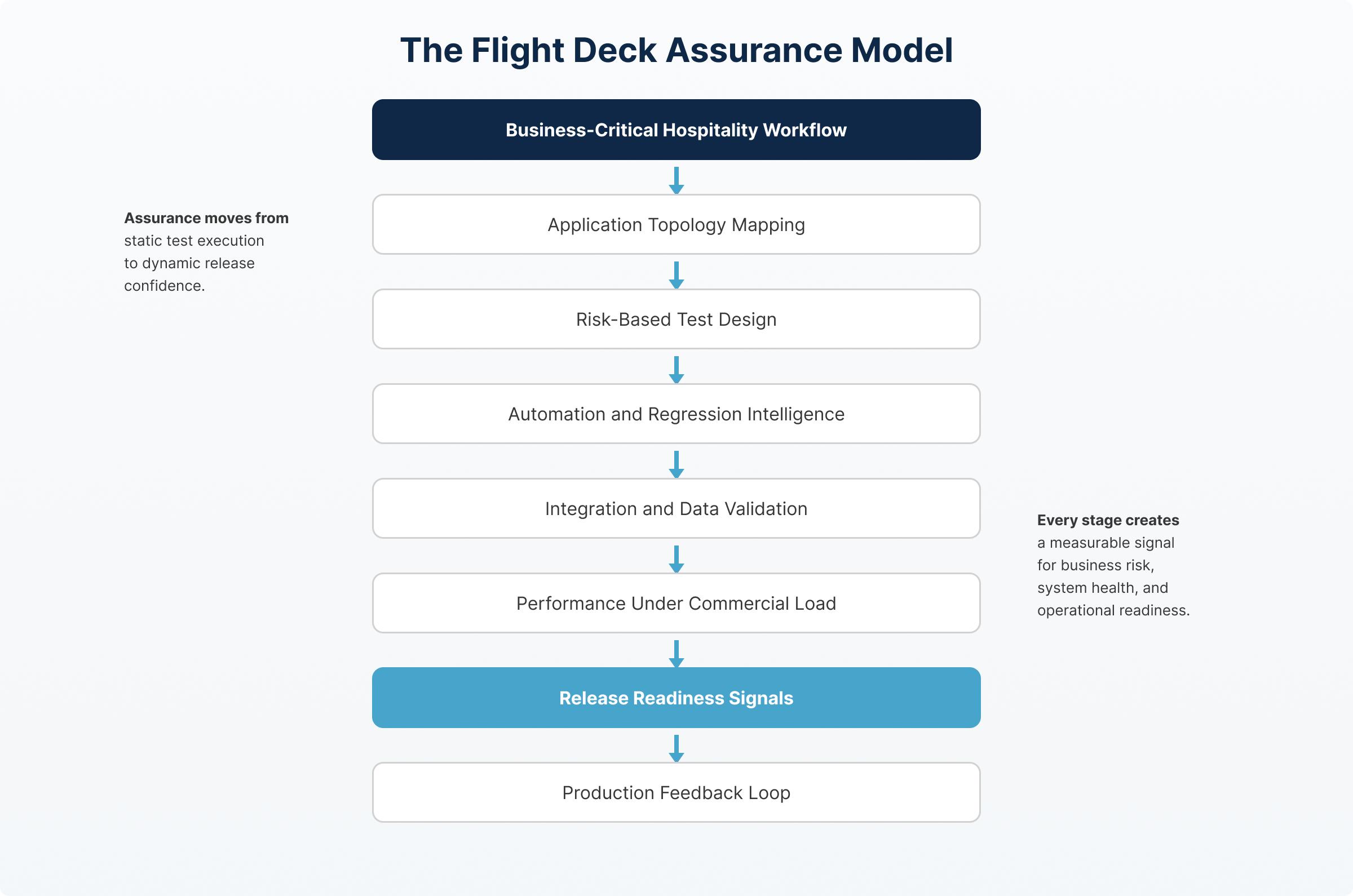
This is why engineered assurance must begin with a map of the business workflow, not just a list of test cases.
Mapping the Real Application Topology
One of the weaknesses of traditional QA is that test assets often do not reflect the actual system architecture. Teams may have thousands of test cases, but still lack a clear answer to basic questions: which systems does this workflow touch, which APIs are involved, what data moves between systems, which regression tests are relevant to this change?
This is the first job of the Agentic Framework's AI-assisted layer — synthesizing requirements, APIs, defect history, and production incidents into a living quality map, so teams start from a structured impact map instead of discovery from scratch. That knowledge base becomes an assurance asset: it helps teams understand what is connected, what is changing, what is at risk, and where testing should be focused, and it lets automation map to real business impact instead of static scripts alone.
Automation That Protects Business Workflows
Automation is essential, but automation alone is not the goal. Many organizations automate test cases without rethinking the underlying assurance model — converting manual scripts into automated scripts and expecting transformation. That creates faster execution, but not necessarily better confidence.
The stronger approach is to automate around business workflows and risk patterns.
Automation Layer | What It Validates |
|---|---|
UI automation | Guest-facing flows such as search, booking, check-in, profile updates, and loyalty redemption |
API automation | Booking, inventory, pricing, payment, CRM, and PMS data exchange |
Contract testing | Whether services continue to meet agreed request and response expectations |
Data validation | Whether rates, availability, guest profiles, offers, and transactions remain consistent |
Regression intelligence | Which tests should run based on the systems and workflows affected by a change |
Performance testing | Whether key workflows hold under seasonal, campaign, or event-driven load |
Monitoring and production checks | Whether post-release behavior matches expected operational patterns |
This is supported by our accelerator repository — Playwright, RestAssured, and Tosca for automation, ReadyAPI and k6 for API and performance testing, Jenkins, GitHub, Docker, and SonarQube for CI/CD — with 83% of priority regression automated and 90%+ of automation suites integrated into CI/CD pipelines across our practice. But the tool is not the strategy. The strategy is to engineer coverage around the workflows that matter most to the guest and the business.
Testing Under Commercial Load
Hospitality platforms do not fail only because of functional defects. They also fail because real-world conditions expose weaknesses that controlled test environments miss.
Engineered assurance includes testing under commercial load — modeling demand spikes around local events, seasonal booking surges, flash promotions, group booking activity, and loyalty campaign launches, rather than running generic performance tests at the end of a release. Using approved tools such as JMeter, k6, NeoLoad, Dynatrace, and AWS CloudWatch, we've modeled 2M+ concurrent users in recent engagements.
The question is not simply, "Can the system handle traffic?" The better question is: can the business workflow remain reliable when demand, data, integrations, and guest behavior are all changing at once?
Release Readiness Should Be Measured, Not Assumed
In traditional QA, release readiness is often summarized by test pass rates and defect counts. Those are useful indicators, but they do not tell the whole story. A release may have a high pass rate and still carry unacceptable business risk if critical workflows were not validated, automation coverage is weak, or integration defects remain unresolved.
This is why release readiness needs to be measured holistically — which is the exact job of the Quality Command Center. QCC's Release Health Summary combines workflow coverage, integration health, automation stability, performance confidence, and environment stability into a single readiness score, rather than leaving leaders to infer safety from a pass rate alone.
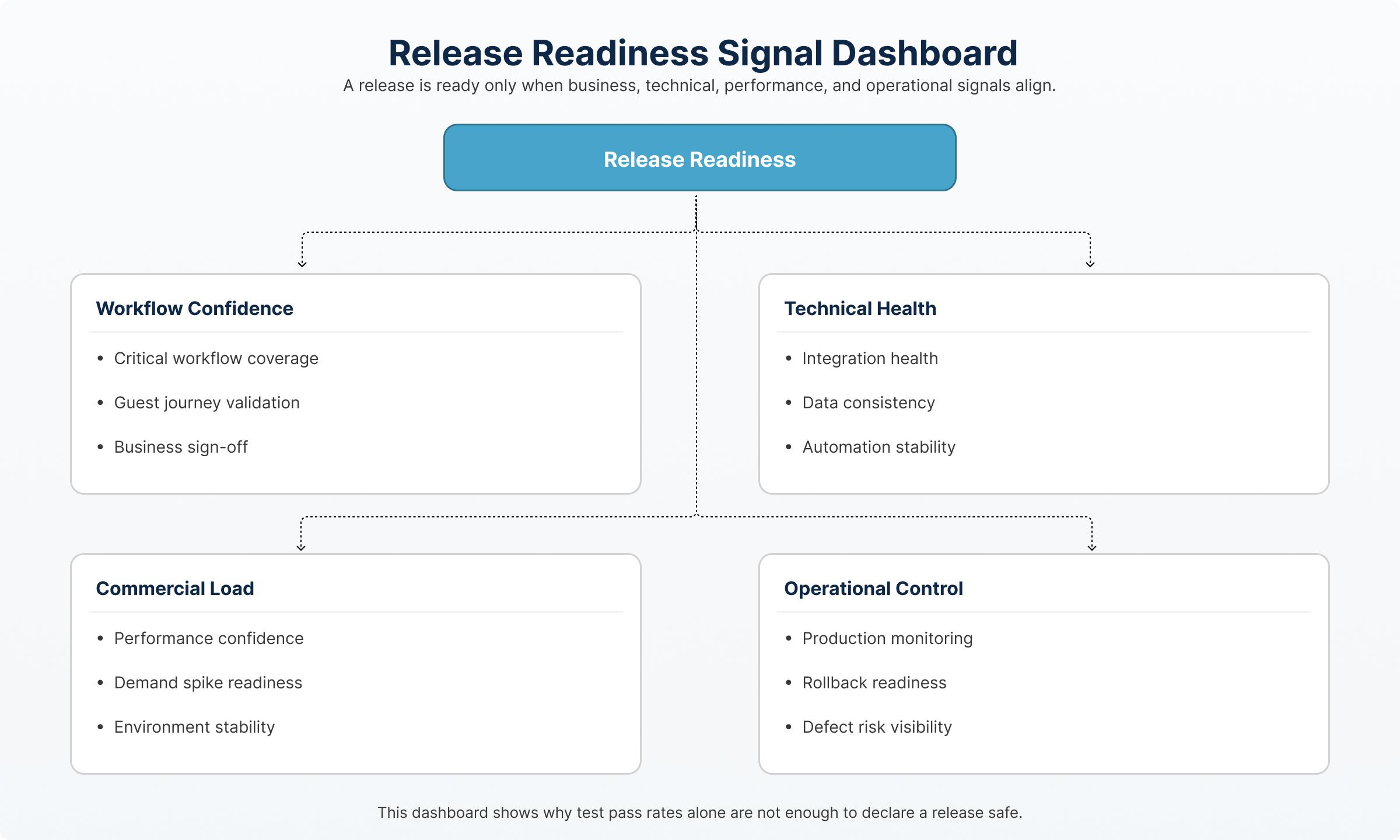
Signal | Why It Matters |
|---|---|
Critical workflow coverage | Confirms that business-important journeys were validated |
Automation pass rate | Shows whether core regression checks are stable |
Defect severity and business impact | Separates cosmetic issues from revenue or guest-impacting risks |
Integration health | Validates system-to-system reliability |
Data consistency | Confirms that inventory, pricing, guest, and transaction data remain accurate |
Performance indicators | Shows whether workflows can support expected demand |
Test environment stability | Prevents false confidence from unreliable environments |
Production monitoring plan | Ensures post-release issues can be detected quickly |
In recent releases tracked through QCC, this model has supported release readiness scores in the 90%+ range, environment stability near 98%, and production defect leakage below 2% — evidence-based numbers, not an assumption based on a passing test suite. Instead of asking whether QA is finished, leaders can ask whether the release is safe for the business.
Why This Matters Now
Hospitality technology is moving quickly. AI-assisted pricing, personalized offers, mobile-first guest journeys, digital check-in, and real-time operational platforms are becoming normal expectations. But speed without assurance creates risk — a faster release cycle is valuable only if the organization can trust what it releases. Otherwise, velocity simply means defects reach guests faster.
The most advanced hospitality technology organizations will not be the ones that test the most manually. They will be the ones that engineer assurance into the way software is designed, built, integrated, released, and monitored. That is the shift from QA as a function to quality engineering as a business capability.
The mroads Perspective
mroads approaches quality engineering as an engineered business control, not a post-development checkpoint.
Our focus is not limited to whether individual screens load or whether isolated test cases pass. We help teams understand how hospitality platforms behave as connected business engines: how systems interact, how data moves, how workflows fail, how automation should be designed, and how release readiness should be measured.
Through the Agentic Framework, layered validation across the technology stack, the Quality Command Center, and the 7-Dimension QA Scorecard, mroads helps hospitality technology teams move from reactive patching to proactive reliability. The goal is simple: close the Velocity Gap without compromising guest experience, revenue integrity, or operator confidence.
Conclusion
Hospitality leaders do not need more QA activity for its own sake. They need engineered assurance.
They need a quality model that understands the real complexity of hospitality platforms: booking journeys, inventory synchronization, pricing intelligence, loyalty rules, payment integrations, mobile experiences, channel distribution, and property-level operations.
Traditional QA can confirm whether features work. Engineered assurance confirms whether the business can trust the platform under real operating conditions.
That is the future of hospitality quality engineering. Not more manual bottlenecks. Not late-cycle firefighting. Not release confidence based on hope.
Engineered for reliability, velocity, and guest trust.

Quality Engineering Team