Hospitality systems rarely fail in isolation.

A mobile app may look functional. An API may return a successful response. A database may record a transaction. A digital key may activate when tested independently. But the guest experience can still fail when these components are required to work together in real time.
That is the core challenge of hospitality quality engineering.
Modern hospitality platforms are not single applications. They are connected ecosystems made up of mobile apps, web portals, property management systems, payment gateways, loyalty engines, distribution systems, event queues, cloud services, databases, and connected guest devices.
A guest does not experience these systems separately. A guest experiences the journey.
That journey may begin with a mobile check-in, continue through identity verification, trigger room assignment, update the PMS, validate payment, notify property operations, and activate a digital key. If any part of that chain slows down, loses data, or enters an inconsistent state, the outcome is not a technical inconvenience. It is a failed arrival experience.
This is why testing components in isolation is no longer enough. Hospitality leaders need a technical assurance model that validates the full ecosystem, not just the visible application layer.
At mroads, this is built directly into how we structure test execution: not as one generic phase, but as four correlated validation layers — Edge & Experience, Services & Messaging, Persistence & State, and Infrastructure & Performance — that map onto the Functional, Automated, API/Integration, and Performance disciplines already embedded in our Quality Engineering framework.
Why Hospitality QA Is an Ecosystem Problem
Hospitality architecture is fragmented by nature.
Many hotel technology environments have evolved over years of platform additions, vendor integrations, property-level customization, and modernization efforts. A brand may run cloud-native applications for guest engagement while still depending on legacy back-end systems for property operations. It may run modern APIs next to older batch processes, and rely on third-party payment services, distribution channels, loyalty platforms, and hardware vendors.
This creates a layered architecture where quality risks often appear between systems.
A mobile check-in issue may not originate in the mobile app. It may come from delayed PMS synchronization. A payment failure may not come from the payment screen. It may be caused by a timeout in a downstream authorization service. A digital key delay may not be a hardware issue. It may be caused by a queue backlog or a stale room assignment state.
Traditional QA often tests what is easiest to observe: the interface. But in hospitality, the most damaging failures often happen underneath it.
Why Isolated Testing Fails
Testing components individually is still necessary. UI tests, API tests, database checks, and integration tests all have value. The problem is relying on isolated validation as the primary source of release confidence.
A hospitality workflow can fail even when individual components appear healthy, because the failure often sits in the interaction:
Isolated Test Result | Hidden Ecosystem Risk |
|---|---|
Mobile app screen loads correctly | API response time may still create guest friction |
API returns a valid response | Payload schema may not match downstream expectations |
PMS update succeeds | Data may arrive too late for the next service in the journey |
Payment authorization works | Retry behavior may fail during network instability |
Database write is successful | Another process may read stale state before the write is committed |
Digital key activates in a test environment | Property network latency may delay real-world activation |
Autoscaling works under generic load | Critical workflows may still degrade during peak guest activity |
Traditional QA asks whether each part works. Layered validation asks whether the complete business journey works across all parts. That distinction is critical — and it's why our Quality Engineering framework treats Functional, Automated, API/Integration, and Performance testing as one connected execution stage rather than four separate disciplines.
The Four Validation Layers
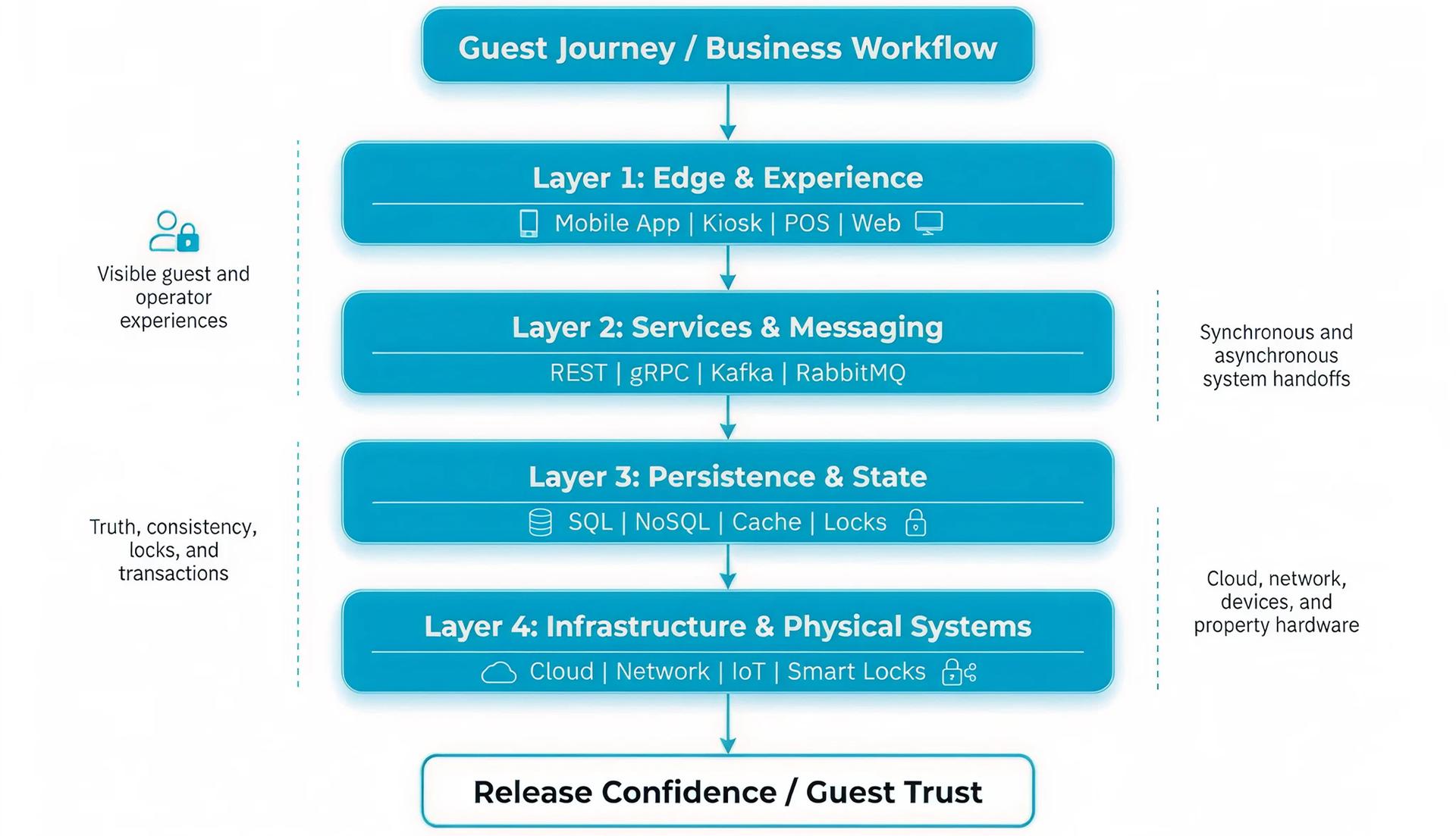
The model correlates quality signals across four layers:
- Edge & Experience
- Services & Messaging
- Persistence & State
- Infrastructure & Physical Systems
These layers are not tested as separate silos. They are validated together so teams can see where a journey slows, breaks, retries, loses data, or enters an inconsistent state — and the results feed the same Quality Command Center used for release-readiness decisions.
QCC Technical Stack
Validating the complete hospitality guest journey across interfaces, services, state, infrastructure, and physical systems.
Layer 1: Edge & Experience
The edge and experience layer is where guests and operators interact with the system — mobile apps, web booking flows, front-desk applications, guest portals, and property-level operational screens.
Traditional QA often spends significant effort here because this layer is visible. That work matters, but it isn't enough. In our model, the edge layer is validated not only for usability and functionality, but as the starting point for downstream signal tracking.
Validation Area | What It Means in Hospitality |
|---|---|
Device and channel behavior | Mobile, web, kiosk, POS, and tablet experiences behave consistently |
Guest journey completion | Guests can search, book, check in, pay, redeem offers, and access services |
Operator workflow efficiency | Front-desk, housekeeping, and property teams can complete tasks without friction |
Error handling | Users receive clear guidance when downstream systems fail or delay |
Signal capture | User actions generate traceable events across downstream services |
A guest taps Check In on the mobile app. A traditional UI test confirms the button works and the next screen appears. Layered validation goes further: did the request reach the correct service, did the reservation state update, did the PMS confirm the update, was the digital key generated, and did the guest receive confirmation within an acceptable time? The edge is not the end of the test. It is the beginning of the trace.
Layer 2: Services & Messaging
The services and messaging layer is where much of the real complexity lives. Hospitality platforms rely on a combination of synchronous APIs and asynchronous messaging — a booking update may trigger an event that needs to flow to the PMS, CRM, loyalty system, and guest notification service.
If this layer is not validated carefully, defects remain invisible until production. A message may be malformed. A schema may drift. An API may return a successful status but omit a required field. A retry may create a duplicate transaction.
Validation Area | What It Means in Hospitality |
|---|---|
API contracts | Services send and receive expected request and response structures |
Schema validation | Event payloads contain required fields in expected formats |
Message delivery | Events are published, consumed, retried, and acknowledged correctly |
Queue behavior | Queue depth, lag, retry rate, and dead-letter behavior are monitored |
Service dependencies | Downstream services respond within acceptable thresholds |
This is exactly the layer where our API and integration testing accelerator — built on tools such as ReadyAPI and RestAssured — earns its keep. We validated this approach directly with a client on the ARA project, where a Playwright and ReadyAPI proof of concept confirmed that UI and API validation could be correlated within a single automated flow rather than tested as disconnected checks.
A room assignment service publishes an event after check-in. If the event schema changes without downstream alignment, the PMS may reject the message or process it incorrectly — even though a UI test still shows a confirmation screen. That is why schema and message validation are essential in hospitality QA architecture.
Layer 3: Persistence & State
The persistence and state layer determines whether the system records the right truth at the right time. Room availability, reservation status, payment authorization, guest profile data, and loyalty eligibility all depend on accurate, timely state management.
The risk is not only whether data is saved. The risk is whether the correct state is available to the correct system at the correct moment.
Validation Area | What It Means in Hospitality |
|---|---|
Transaction consistency | Reservation, payment, inventory, and guest data remain aligned |
Read/write behavior | Systems do not read stale state after a critical update |
Locking and concurrency | Simultaneous actions do not create double booking or inconsistent inventory |
Recovery and rollback | Failed workflows do not leave partial or corrupted states |
Auditability | Critical state changes are traceable across systems |
This is also where our Test Data Engineering capability matters — context-aware synthetic data generation, automated masking and subsetting, and continuous data quality validation ensure the state being tested is production-representative rather than synthetic in the misleading sense.
Two guests attempt to book the last available room type through different channels. Both systems may appear to function correctly, but without proper locking and inventory-state validation, the property can be oversold. Persistence testing is not just database testing. It is business-truth validation.
Layer 4: Infrastructure & Performance
The final layer includes cloud infrastructure, networks, property connectivity, and the systems that determine whether the digital experience holds up under real conditions — and, where physical outcomes are involved, whether a digital key actually opens a door.
Cloud-native performance matters most here. During peak seasons, event weekends, or large group arrivals, infrastructure must scale without degrading workflows.
Validation Area | What It Means in Hospitality |
|---|---|
Autoscaling behavior | Services scale during booking surges or mobile check-in windows |
Network resilience | Property-level connectivity issues do not create unrecoverable failures |
Latency tolerance | Outcomes occur within acceptable guest-experience thresholds |
Observability | Logs, metrics, and traces are available for root-cause analysis |
Degraded mode behavior | Systems respond predictably when infrastructure components are unavailable |
We treat performance testing as an early-warning capability rather than a final checkpoint, aligning with Marriott-style CI/CD and release processes using tools such as JMeter, k6, NeoLoad, Dynatrace, and AWS CloudWatch. In recent engagements, this approach has supported modeling of 2M+ concurrent users, alongside a 38% reduction in regression and validation cycle time and a 53% reduction in post-deployment verification effort.
The Four-Layer Model, Summarized
Layer | What It Validates | Hospitality Example | Failure Signal |
|---|---|---|---|
Edge & Experience | Guest and operator interaction points | Mobile check-in, web booking | UI latency, failed submission |
Services & Messaging | APIs, schemas, queues, service handoffs | PMS sync, payment authorization, room assignment event | Schema mismatch, timeout, queue backlog |
Persistence & State | Data consistency, locks, transactions | Room inventory, guest profile, reservation status | Stale data, write conflict, inconsistent state |
Infrastructure & Performance | Cloud, network, scaling behavior | Digital key activation, autoscaling under peak load | Device failure, scaling lag, network instability |
This model helps QA and engineering teams move from surface-level validation to ecosystem assurance.
Correlated Validation: Finding the Real Source of Failure
The real value of this model isn't only that it validates four layers — it's that it correlates signals across those layers.
When a guest-facing workflow fails, teams need to know where the breakdown occurred: did the mobile app submit the request, did the API receive it, was the queue delayed, did the database lock the record, did the PMS confirm the state change?
Without correlated validation, teams often guess. The front-end team blames the API. The API team blames the message broker. The database team points downstream. This model replaces blame with traceability — and this is precisely where our Quality Command Center (QCC) does its work. QCC's Integration view (E2E) tab and AI-assisted defect RCA loop exist to trace a symptom back through every layer until the real bottleneck is visible; in recent engagements, this loop has reduced defect mean-time-to-resolution by roughly 40%.
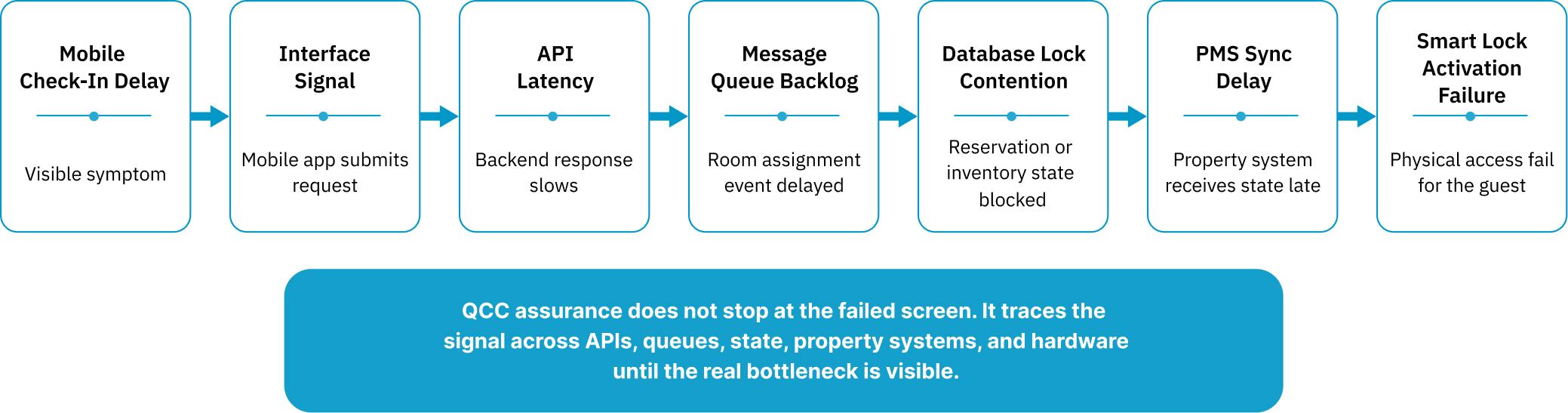
A visible mobile check-in delay, for example, might trace back through API latency, a message queue backlog, database lock contention, and a delayed PMS sync — with the smart-key activation failure as the guest-visible endpoint. QCC's correlation view exists to make that chain visible instead of leaving teams to guess at the layer boundary.
Signal Traceability Across the Guest Journey
A visible guest delay may originate several layers below the interface.
Observability as Release Intelligence
Observability is often discussed as a production operations capability. In hospitality quality engineering, it should also be part of release readiness.
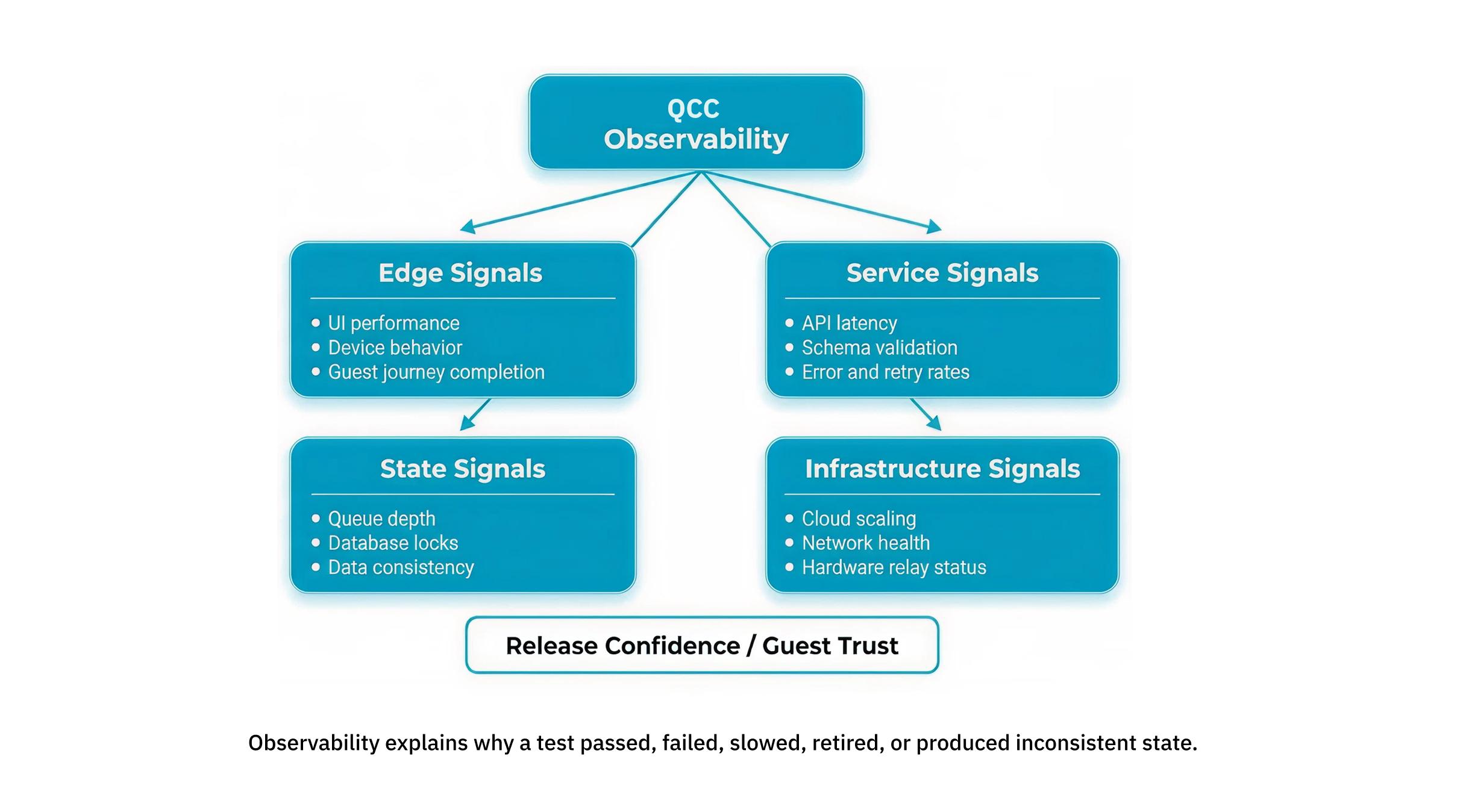
A test result tells you whether a scenario passed or failed. Observability helps explain why. Using logs, metrics, traces, and system signals — through tools such as Dynatrace, Splunk, and BigPanda — teams can identify latency patterns, queue delays, API failure rates, and scaling behavior before they reach guests.
Signal | What It Reveals |
|---|---|
UI performance | Whether guest-facing experiences are responsive |
API latency | Whether services are slowing down key workflows |
Schema validation failures | Whether services or events are drifting from agreed contracts |
Queue depth and lag | Whether asynchronous workflows are falling behind |
Database lock contention | Whether state updates are creating delays or conflicts |
Autoscaling events | Whether infrastructure responds to demand at the right time |
Guest journey completion | Whether the full workflow succeeds from start to finish |
This is where QA becomes more than test execution. It becomes release intelligence — the same evidence-based view that populates our QCC dashboard's Environment Health and Release Risk Heatmap panels.
QCC Observability View
Turning logos, traces metrics, and device signals into release intelligence.
How This Changes Test Automation
In many organizations, test automation begins by converting manual test cases into scripts. That can improve execution speed, but it does not automatically improve assurance.
Automation built around this model is structured around business journeys, technical layers, and correlated signals — not just visible UI paths. A mobile check-in test should not only confirm that the screen changes. It should validate the API response, event publication, state transition, PMS synchronization, and digital key readiness together.
Traditional Automation | Layered Automation |
|---|---|
Automates visible UI paths | Automates end-to-end guest journeys |
Validates expected screen behavior | Validates workflow behavior across layers |
Produces pass/fail results | Produces traceable release-readiness signals |
Runs scripts after development | Aligns automation with architecture, risk, and business workflows |
Focuses on regression speed | Focuses on confidence, diagnosability, and resilience |
Treats failures as test defects | Traces failures to services, data, queues, or infrastructure |
Our accelerator repository — Playwright, RestAssured, and Tosca for automation; ReadyAPI and k6 for API and performance validation; Jenkins, GitHub, Docker, and SonarQube for CI/CD — supports this approach directly, with 83% of priority regression automated and 90%+ of automation suites integrated into CI/CD pipelines across our practice. But the tool is not the architecture. The architecture is the ability to validate the guest journey across layers.
Where AI Can Help
AI can support this model when applied carefully, through the same Agentic Framework that governs the rest of our AI-assisted Quality Engineering practice. AI can help identify which workflows are impacted by a schema change, recommend regression coverage based on historical defect patterns, summarize log and trace signals after a test failure, and group related defects by probable root cause.
AI should not be treated as a substitute for governance. Hospitality systems carry real commercial and guest-experience risk. Every AI-generated recommendation moves through engineer review before it becomes part of the assurance framework — AI supports the process; it does not bypass it.
The mroads Perspective
mroads uses this layered validation model to help hospitality technology teams move beyond isolated QA." as per figma.
Our focus is on validating how the ecosystem behaves: how interfaces trigger services, how messages move, how state changes, and how infrastructure responds — and how all of these signals combine, visible in one place, to shape the guest journey.
If the mobile interface lags, the answer is not simply "front-end issue." The delay may come from API latency, queue backlog, database lock contention, or PMS synchronization. This model — and the Quality Command Center that sits on top of it — traces the journey until the real source is visible.
That is the difference between testing components and engineering assurance.
Conclusion
Hospitality QA must evolve because hospitality systems have evolved.
The modern guest journey is not contained inside one application. It crosses mobile interfaces, APIs, event queues, databases, cloud infrastructure, and property systems. Testing each component separately may prove that individual parts work, but it does not prove that the business journey is reliable.
This layered model — Edge & Experience, Services & Messaging, Persistence & State, and Infrastructure & Performance — provides a more complete view, correlated through the Quality Command Center so teams can identify where failures actually occur.
For hospitality leaders, this matters because guest trust depends on the full ecosystem. A successful release is not one where the app works in a test environment. It is one where the guest can complete the journey, the property can operate confidently, the systems remain synchronized, and the business can trust the platform under real-world conditions.
That is the future of hospitality quality engineering: not isolated testing, but orchestrated assurance.

Quality Engineering Team